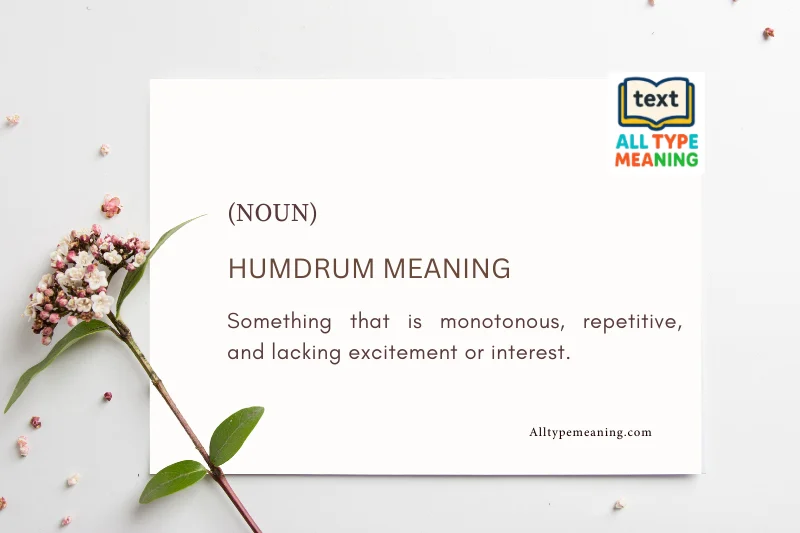
The term Humdrum Meaning may seem straightforward, yet it conveys a significant message about life and language. To put it simply, “humdrum” describes something that is boring, repetitive, or devoid of excitement. Grasping this word can enhance your ability to depict everyday scenarios more vividly, whether it’s a monotonous work routine, a tedious lecture, or a dull chore at home.
Understanding the meaning and application of humdrum is particularly beneficial for students gearing up for exams, professionals aiming to enhance their communication skills, and language learners who wish to broaden their vocabulary. By delving into its meaning, synonyms, and examples, you can articulate your thoughts more clearly and make your writing or speech more captivating and precise.
Humdrum: Quick Stats Overview
| Aspect | Details |
|---|---|
| Word Type | Adjective & Noun |
| Origin | Early 16th century (1550s) |
| Syllables | 2 (hum-drum) |
| Pronunciation | /ˈhʌmdrʌm/ |
| Synonyms Count | 25+ common alternatives |
| Usage Frequency | Medium (commonly used in literature) |
| Difficulty Level | Intermediate |
| Common Contexts | Daily life, work routines, literature |
The Complete Definition of Humdrum
What Is the Humdrum Def?
The humdrum definition is quite straightforward yet powerful. When we talk about something being humdrum, we’re describing it as:
As an Adjective:
- Lacking excitement, variety, or interest
- Monotonously dull and routine
- Commonplace and ordinary to the point of boredom
- Characterized by tedious repetition
As a Noun:
- A monotonous routine or dull activity
- The quality of being boring and predictable
The word “humdrum” paints a picture of something so ordinary and repetitive that it fails to stimulate our interest or emotions. It’s not necessarily negative in a harmful way, but it describes that gray area of life where nothing particularly exciting or noteworthy happens. 📉
Breaking Down the Humdrum Meaning
To truly understand the humdrum meaning, think about your typical weekday morning: wake up, brush your teeth, eat breakfast, commute to school or work, and repeat the same pattern day after day. When this routine becomes so predictable that it no longer engages your mind or spirit, it becomes humdrum.
The beauty of this word lies in its ability to capture a very specific feeling that most people experience but struggle to articulate. It’s different from “boring” because something can be boring for a short time, but humdrum implies a sustained, ongoing state of dullness that has become part of the fabric of daily life.
Key Characteristics of Humdrum Situations:
- Repetitive patterns without variation
- Lack of spontaneity or surprise
- Predictable outcomes
- Absence of excitement or novelty
- Routine-driven activities
Etymology and Origins: Where Did Humdrum Come From?
Understanding the humdrum meaning becomes easier when we explore its origins. The word dates back to the 16th century, around the 1550s, and is a reduplicative formation—created by combining similar-sounding syllables, a technique also seen in words like helter-skelter, wishy-washy, and topsy-turvy.
The Birth of Humdrum
The word is believed to be a reduplicative formation, which means it was created by combining similar-sounding syllables. This linguistic technique was quite popular in English and gave us other words like “helter-skelter,” “wishy-washy,” and “topsy-turvy.”
The “Hum” Component: The first part, “hum,” likely comes from the droning, monotonous sound of humming. Think about how a continuous humming sound can become background noise that’s neither interesting nor unpleasant – just there, constant and unchanging.
The “Drum” Component: The second part, “drum,” probably refers to the repetitive beating of a drum. When a drum beats in the same pattern over and over, it creates a monotonous rhythm that mirrors the repetitive nature of boring routines.
Together, “humdrum” creates a word that sounds like what it means – a dull, repetitive drone that characterizes monotonous experiences. This is an example of onomatopoeia at work, where the sound of the word reflects its meaning. 🥁
Humdrum in Real Life: Practical Usage and Examples
Now that we understand the definition of humdrum, let’s explore how to use it correctly in everyday conversation and writing.
Examples in Sentences
In Daily Conversation:
- “After five years at the same job doing the same tasks, my work life has become quite humdrum.” 💼
- “She decided to take a spontaneous trip to break free from her humdrum routine.”
- “The movie started with promise but quickly descended into a humdrum plot that was easy to predict.”
- “Living in a small town can sometimes feel humdrum when you’re craving adventure and excitement.”
- “His humdrum existence changed dramatically when he discovered his passion for photography.” 📸
In Professional Writing:
- “The committee’s humdrum approach to innovation prevented the company from adapting to market changes.”
- “Despite the humdrum nature of administrative tasks, they remain essential to organizational success.”
- “The author transformed humdrum everyday experiences into captivating narratives.”
In Creative Writing:
- “The humdrum ticking of the old clock was the only sound in the dusty attic.”
- “She escaped the humdrum reality of her life through the pages of adventure novels.”
Common Collocations
Words that frequently appear with “humdrum” include:
- Humdrum existence
- Humdrum routine
- Humdrum life
- Humdrum job
- Humdrum duties
- Humdrum tasks
- Humdrum world
- Humdrum reality
Synonyms and Antonyms: Expanding Your Vocabulary
To fully master the humdrum def, it’s helpful to know related words that can add variety to your expression.
Synonyms (Similar Meanings) 👍
Common Synonyms:
- Monotonous
- Boring
- Dull
- Tedious
- Mundane
- Routine
- Ordinary
- Commonplace
- Prosaic
- Tiresome
- Repetitive
- Uninteresting
- Dreary
- Bland
- Lackluster
More Sophisticated Alternatives:
- Quotidian (relating to daily routine)
- Banal (lacking originality)
- Pedestrian (lacking inspiration)
- Uninspiring
- Uneventful
Antonyms (Opposite Meanings) 👎
Understanding opposites helps clarify the humdrum meaning:
- Exciting
- Thrilling
- Stimulating
- Fascinating
- Interesting
- Dynamic
- Engaging
- Captivating
- Extraordinary
- Remarkable
- Novel
- Fresh
- Innovative
- Adventurous
- Exhilarating
When to Choose Humdrum Over Other Words
While many synonyms exist, “humdrum” has a unique quality that makes it special:
- Use “boring” when something is temporarily uninteresting
- Use “monotonous” when emphasizing repetitive sameness
- Use “mundane” when describing ordinary worldly matters
- Use humdrum when you want to capture the essence of a sustained, routine dullness that has become the normal state of affairs 🎯
Humdrum in Different Contexts: From Literature to Pop Culture
The humdrum meaning finds relevance across literature, psychology, work, and media, enriching our understanding of daily monotony.
In Literature and Poetry 📖
Many famous writers have used “humdrum” to describe characters’ lives or settings:
Writers like Charles Dickens, Virginia Woolf, and George Orwell have employed this word to contrast the ordinary with the extraordinary, or to highlight characters’ desires to escape their mundane circumstances.
Literary Function: In literature, describing something as humdrum often serves to:
- Establish a baseline of normalcy before dramatic events
- Show character dissatisfaction and motivation for change
- Create contrast with more exciting plot developments
- Reflect social commentary on modern life
In Psychology and Well-being 🧠
Psychologists recognize that prolonged exposure to humdrum routines can affect mental health:
- Routine Fatigue: When daily life becomes too humdrum, people may experience decreased motivation and engagement
- Need for Variety: Human psychology requires some level of novelty and stimulation
- Breaking the Cycle: Mental health professionals often recommend introducing small changes to combat humdrum existence
In Work and Career Contexts 💼
The workplace is perhaps where people most commonly experience humdrum conditions:
- Job Satisfaction: When work becomes humdrum, employee engagement typically decreases
- Career Development: Many people change careers to escape humdrum professional lives
- Innovation Challenges: Humdrum thinking in organizations can stifle creativity and growth
In Modern Media and Entertainment 📺
The concept of humdrum appears frequently in:
- Self-help books about breaking free from routine
- Travel blogs promoting adventure over humdrum existence
- Lifestyle magazines offering tips to “spice up” humdrum lives
- Social media discussions about work-life balance
Breaking Free: Transforming Humdrum into Extraordinary
While understanding the humdrum definition is valuable, many people want to know how to overcome humdrum situations in their own lives. Here are practical strategies:
Small Changes, Big Impact
- Vary Your Routine: Take a different route to work or school
- Try New Experiences: Learn a new skill or hobby each month 🎸
- Meet New People: Expand your social circle beyond usual contacts
- Set Fresh Goals: Create challenges that excite and motivate you
- Practice Mindfulness: Find interest in present moments rather than going through motions
Reframing Perspective 🔄
Sometimes what seems humdrum contains hidden richness:
- Look for small details you’ve overlooked
- Appreciate the stability that routine provides
- Find meaning in simple, repeated actions
- Recognize that not every moment needs to be thrilling
The Balance Philosophy
While escaping humdrum existence sounds appealing, some routine provides:
- Stability and Security: Predictability reduces stress
- Efficiency: Established routines save mental energy
- Foundation for Creativity: Regular habits can free your mind for creative thinking
The goal isn’t to eliminate all routine but to prevent life from becoming entirely humdrum without variation or joy. ⚖️
Common Mistakes and Correct Usage
Pronunciation Errors ❌
Incorrect: “HUM-drum” (equal stress) Correct: “HUM-drum” (stress on first syllable) ✅
Grammatical Usage
As an Adjective: ✅ Correct: “It was a humdrum day.” ❌ Incorrect: “The day was very humdrum boring.” (redundant)
As a Noun: ✅ Correct: “She wanted to escape the humdrum of daily life.” ❌ Incorrect: “She wanted to escape the humdrums.” (not typically pluralized)
Overuse Warning ⚠️
While “humdrum” is a useful word, avoid using it too frequently in a single piece of writing. Vary your vocabulary with synonyms to keep your own writing from becoming humdrum! 😊
Why Learning Words Like Humdrum Matters
Expanding your vocabulary with words like “humdrum meaning” offers several benefits:
Academic Advantages 📚
- Better Writing: Express ideas more precisely
- Exam Performance: Vocabulary knowledge improves reading comprehension
- Critical Thinking: More words mean more nuanced thinking
Professional Benefits 💼
- Communication Skills: Articulate ideas clearly in workplace settings
- Professional Image: Strong vocabulary suggests competence and education
- Career Advancement: Better communication often leads to better opportunities
Personal Growth 🌱
- Self-Expression: Find exactly the right words for your feelings
- Cultural Literacy: Understand literature, media, and conversations better
- Cognitive Benefits: Learning new words keeps your brain active and healthy
Conclusion:
The term “humdrum meaning” refers to something that is monotonous, repetitive, and devoid of excitement. As an adjective, it characterizes dull routines, whereas as a noun, it denotes predictable and tedious activities. This word, which originated in the 16th century, reflects the repetitive sounds of “hum” and “drum,” symbolizing the mundane patterns of life. A comprehension of humdrum enables students, professionals, and language learners to articulate prolonged dullness with greater precision.
Frequently encountered in literature, psychology, work, and everyday life, the term underscores the fatigue associated with routine and the necessity for variety. Although it carries a mildly negative connotation, humdrum can also offer a sense of stability, rendering it a versatile term for depicting ordinary yet familiar experiences. Discover our full guide on skedaddle meaning and see how this quirky term is influencing India’s lifestyle trends and online conversations.
Frequently Asked Questions
1. What is the exact definition of humdrum?
Humdrum meaning lacking excitement, variety, or interest; monotonously dull and routine. As an adjective, it describes something boring and repetitive. As a noun, it refers to a monotonous routine or the quality of being dull. For example: “Her humdrum job offered no opportunities for creativity.” The word perfectly captures that feeling when daily life becomes so predictable it no longer engages your interest or enthusiasm.
2. How do you use humdrum in a sentence?
You can use humdrum as an adjective before a noun or after a linking verb. Examples include: “The humdrum routine exhausted her” (before noun), “His life had become humdrum” (after linking verb), or “She wanted to escape the humdrum of suburban life” (as a noun). The key is using it to describe situations, activities, or lifestyles that are monotonous and lacking excitement. It’s perfect for expressing dissatisfaction with repetitive daily patterns.
3. What’s the difference between humdrum and boring?
While both words describe lack of interest, “boring” is more general and can apply to short-term experiences, like a boring movie or boring conversation. Humdrum specifically refers to ongoing, routine dullness – it suggests a sustained state of monotony that has become part of daily life. Something can be boring for an hour, but humdrum describes a lifestyle or extended situation. Humdrum also carries connotations of routine and predictability that “boring” doesn’t necessarily imply.
4. Is humdrum a negative word?
Humdrum is generally mildly negative but not harshly critical. It expresses dissatisfaction with monotony rather than intense dislike. While it indicates something lacks excitement, it’s not as strong as words like “terrible” or “awful.” Many people live with humdrum routines without necessarily being unhappy. The word often appears when someone desires change or variety but isn’t in crisis. It’s more about lack of stimulation than actual unpleasantness, making it a relatively gentle criticism.
5. Can humdrum ever be positive?
While humdrum typically has slightly negative connotations, context matters. After a period of chaos or stress, some people might appreciate a “humdrum” routine that provides stability and predictability. The word itself remains neutral in meaning – it simply describes lack of excitement. Whether that’s good or bad depends on individual needs and circumstances. Some people thrive on routine, while others find it stifling. In literature, authors sometimes use humdrum ironically to highlight how people overlook beauty in ordinary moments. The key is balance!
Explore definitions, slang, and vocabulary insights at All Type Meaning. 📚