Have you ever come across the word erstwhile meaning in your reading and wondered what it means? 🤔 You’re not alone! This beautiful English word carries a sense of nostalgia and history that many people find intriguing. Today, we’ll explore the erstwhile meaning in depth, making it easy for students, professionals, and curious minds to understand and use this word confidently.
Whether you’re preparing for competitive exams, improving your vocabulary, or simply love learning new words, this comprehensive guide will help you master the meaning, usage, and cultural significance of “erstwhile.” Let’s dive in! 🚀
What Does “Erstwhile” Mean? 📝
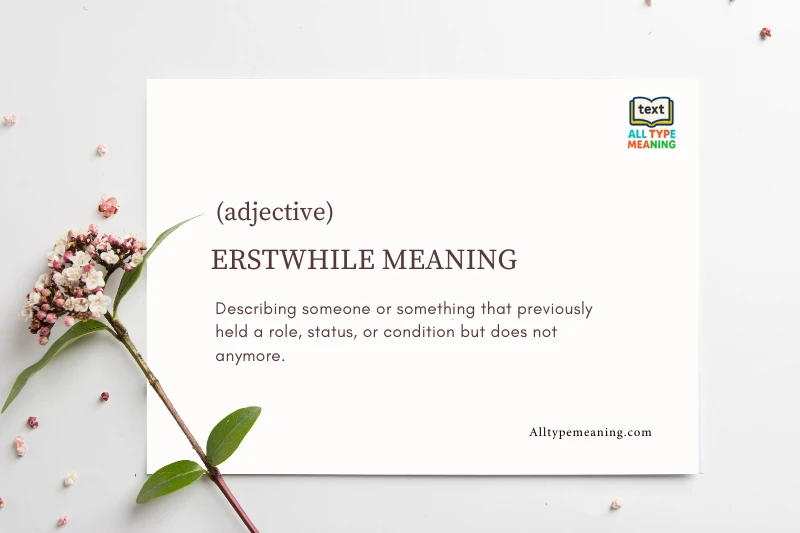
The word “erstwhile” is an adjective that means “former” or “previous.” It refers to something or someone that existed, held a position, or had a particular quality in the past but no longer does so in the present.
Simple Definition: Something that was true before but isn’t true now.
Etymology: The word comes from the German “erst” (meaning “first” or “formerly”) and the English “while” (meaning “time”). Together, they create a word that literally means “at a former time.”
Key Characteristics of “Erstwhile”:
- ✅ Always refers to the past
- ✅ Indicates a change from past to present
- ✅ Often used in formal or literary contexts
- ✅ Carries a slightly nostalgic tone
Examples of “Erstwhile” in Sentences:
- The erstwhile king now lives in exile.
- She visited her erstwhile school after twenty years.
- The erstwhile champion struggled to regain his form.
- The erstwhile friends had grown apart over the years.
Erstwhile Meaning in Different Indian Languages 🇮🇳
Understanding erstwhile meaning in regional languages helps create a deeper connection with the word. Here’s how “erstwhile” translates across various Indian languages:
Erstwhile Meaning in Hindi
Hindi Translation: पूर्व (Purva), भूतपूर्व (Bhootpurva), पहले का (Pehle ka)
- Usage: “वह एक पूर्व राजा था” (He was an erstwhile king)
- Context: Used in formal Hindi literature and news
Erstwhile Meaning in Telugu
Telugu Translation: పూర్వ (Poorva), మునుపటి (Munupati)
- Usage: “అతను పూర్వ మంత్రి” (He is an erstwhile minister)
- Context: Common in Telugu newspapers and official documents
Erstwhile Meaning in Bengali
Bengali Translation: পূর্বতন (Purbatan), আগেকার (Agekar)
- Usage: “তিনি একজন পূর্বতন শিক্ষক” (He is an erstwhile teacher)
- Context: Frequently used in Bengali literature
Erstwhile Meaning in Tamil
Tamil Translation: முன்னாள் (Munnal), பழைய (Pazhaiya)
- Usage: “அவர் முன்னாள் அமைச்சர்” (He is an erstwhile minister)
- Context: Used in Tamil media and formal writing
Erstwhile Meaning in Kannada
Kannada Translation: ಮೊದಲಿನ (Modalina), ಹಿಂದಿನ (Hindina)
- Usage: “ಅವರು ಮೊದಲಿನ ಅಧ್ಯಕ್ಷರು” (He is an erstwhile president)
- Context: Common in Kannada journalism and literature
How to Use “Erstwhile” Correctly: Grammar and Context 📚
Understanding when and how to use “erstwhile” properly is crucial for effective communication. Here are the essential rules and guidelines:
Grammatical Position
“Erstwhile” is an attributive adjective, which means it appears before the noun it modifies:
- ✅ Correct: “The erstwhile champion”
- ❌ Incorrect: “The champion erstwhile”
Formal vs. Informal Usage
Erstwhile is primarily used in:
- 📰 Newspapers and journalism
- 📖 Academic writing
- 🏛️ Historical texts
- 📝 Formal speeches
- 📚 Literature
Avoid using “erstwhile” in:
- 💬 Casual conversations
- 📱 Text messages
- 😊 Informal social media posts
Common Collocations
Words that frequently appear with “erstwhile”:
- Erstwhile leader/ruler/king/queen
- Erstwhile colleague/friend/partner
- Erstwhile champion/winner
- Erstwhile employee/member
- Erstwhile territory/colony
Tone and Connotation
The word “erstwhile” often carries a nostalgic or respectful tone, suggesting that the person or thing being described once held importance or dignity. It’s neither positive nor negative but rather neutral with a historical perspective.
Synonyms and Antonyms of “Erstwhile” 🔄
Synonyms (Words with Similar Meanings):
- Former – Most common substitute
- Previous – Simple and direct
- Past – General term for bygone times
- Bygone – Emphasizes something from long ago
- Quondam – Formal, literary synonym
- One-time – Informal equivalent
- Ex- (as prefix) – Modern usage (ex-president)
- Late – Sometimes used for deceased persons
Antonyms (Words with Opposite Meanings):
- Current – Happening now
- Present – Existing today
- Contemporary – Of the same time period
- Modern – Up-to-date
- Existing – Currently in place
- Active – Currently functioning
- Incumbent – Currently holding office
Usage Comparison:
- “The former president” (neutral, factual)
- “The erstwhile president” (more formal, slightly nostalgic)
- “The ex-president” (informal, modern)
Real-World Examples and Applications 🌍
Understanding Erstwhile Meaning becomes clearer when we see it in various real-world contexts. Here are practical examples from different fields:
In Politics and Governance:
- “The erstwhile Soviet Union dissolved in 1991.”
- “Many erstwhile colonies gained independence in the 20th century.”
- “The erstwhile prime minister addressed the gathering.”
In Business and Corporate World:
- “The erstwhile CEO returned as a consultant.”
- “Many erstwhile employees started their own companies.”
- “The erstwhile market leader faced new competition.”
In Sports and Entertainment:
- “The erstwhile world champion announced his retirement.”
- “Many erstwhile Bollywood stars have turned to direction.”
- “The erstwhile football captain became a coach.”
In Education and Academia:
- “She met her erstwhile professor at the conference.”
- “The erstwhile students organized a reunion.”
- “Many erstwhile researchers have become entrepreneurs.”
In Historical Contexts:
- “The erstwhile Mughal Empire left lasting architectural legacies.”
- “Erstwhile kingdoms merged to form modern states.”
- “The erstwhile trade routes connected distant civilizations.”
Writing Tips for Using “Erstwhile”:
- 🎯 Be Specific: Use it when there’s a clear change from past to present
- 📝 Maintain Formality: Reserve for formal or academic writing
- 🕰️ Consider Timeline: Ensure the past reference is clear
- 🎭 Match Tone: Use when you want a respectful or nostalgic tone
- 📖 Read Aloud: Check if it sounds natural in your sentence
Conclusion: Mastering the Art of Using “Erstwhile” ✨
Understanding the erstwhile meaning opens up new dimensions in your vocabulary and writing skills. This elegant word, with its roots in history and formal literature, adds sophistication and precision to your language use. Whether you’re a student preparing for exams, a professional crafting formal documents, or simply someone who loves the richness of language, mastering “erstwhile” with All Type Meaning enhances your communication abilities.
Remember, the key to using “erstwhile” effectively lies in:
- 🎯 Context: Use it in formal or academic settings
- 📝 Precision: Ensure there’s a clear past-to-present change
- 🌟 Tone: Maintain the respectful, nostalgic quality it carries
- 🗣️ Practice: Gradually incorporate it into appropriate writing
The beauty of erstwhile meaning in different Indian languages shows how universal concepts transcend linguistic boundaries while maintaining their essential meaning. From Hindi’s “पूर्व” to Tamil’s “முன்னாள்,” the concept of “former” or “previous” resonates across cultures and languages.
As you continue your journey of vocabulary building, remember that words like “erstwhile” aren’t just academic exercises—they’re tools that help us express nuanced ideas with greater precision and elegance. Keep exploring, keep learning, and keep growing your linguistic arsenal! 🚀
Frequently Asked Questions (FAQs) ❓
Q: What is the exact meaning of “erstwhile”?
A: Erstwhile means “former” or “previous.” It describes something that existed or was true in the past but is no longer the case in the present. For example, “the erstwhile king” refers to someone who was once a king but no longer holds that position. 👑
Q: Can I use “erstwhile” in everyday conversation?
A: While you can use “erstwhile” in conversation, it’s quite formal and might sound overly sophisticated in casual settings. It’s better to use simpler words like “former” or “ex-” in everyday speech. Save “erstwhile” for formal writing, academic papers, or professional presentations. 💼
Q: Is there a difference between “erstwhile” and “former”?
A: Both words mean essentially the same thing, but “erstwhile” is more formal and literary. “Former” is more commonly used and sounds more natural in most contexts. “Erstwhile” also carries a slightly more nostalgic or respectful tone compared to the neutral “former.” 📊
Q: How do you pronounce “erstwhile”?
A: “Erstwhile” is pronounced as “URST-wile” (IPA: /ˈɜːrstˌwaɪl/). The emphasis is on the first syllable “URST,” and the second part rhymes with “while.” Practice saying it slowly: “URST-while.” 🔊
Q: Can “erstwhile” be used for things that might return in the future?
A: Yes! “Erstwhile” simply indicates that something was true in the past and isn’t true now. It doesn’t prevent the possibility of it being true again in the future. For example, “the erstwhile champion” could potentially become champion again, but currently isn’t. ⚡
📚 To deepen your vocabulary further, explore our complete guide on comprehensive meaning🌟 and learn how to use it effectively in different contexts ✨