✅ Meaning & Explanation
English Meaning:
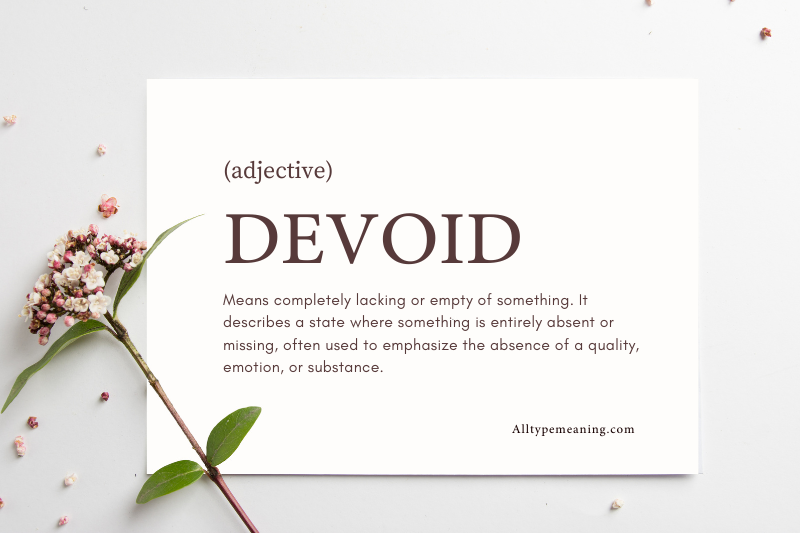
“Devoid” is an adjective that means completely lacking or empty of something. It describes a state where something is entirely absent or missing, often used to emphasize the absence of a quality, emotion, or substance.
Explanation:
The word “devoid meaning” is used to indicate a total absence or lack of something specific. It often carries a formal or literary tone and is typically followed by the preposition “of” to specify what is missing. For example, a place devoid of life is completely empty of living things.
Hindi Meaning & Explanation (हिंदी में अर्थ और व्याख्या):
अर्थ: “Devoid” का हिंदी में अर्थ है “रहित” या “खाली”। यह एक विशेषण है जो किसी चीज की पूर्ण अनुपस्थिति को दर्शाता है।
व्याख्या: “Devoid” का उपयोग तब किया जाता है जब कोई गुण, भावना, या वस्तु पूरी तरह से अनुपस्थित होती है। यह औपचारिक या साहित्यिक संदर्भों में अधिक प्रचलित है और आमतौर पर “of” के साथ प्रयोग होता है, जैसे “जीवन से रहित” का मतलब है कि कोई स्थान पूरी तरह से निर्जन है।
🗂️ Category
-
Part of Speech: Adjective
-
Usage: Formal, literary, or descriptive contexts
-
Field: Commonly used in written English, literature, academic writing, and formal speech
-
Related Fields: Creative writing, journalism, poetry, and everyday conversation (less common)
📝 Examples in Sentences
-
English: The abandoned house was devoid of any signs of life.
Hindi: परित्यक्त घर में जीवन के किसी भी संकेत से रहित था। -
English: Her speech was devoid of humor, making it dull.
Hindi: उनके भाषण में हास्य का अभाव था, जिससे यह नीरस हो गया। -
English: The desert is devoid of water for miles around.
Hindi: रेगिस्तान में मीलों तक पानी से रहित है। -
English: His argument was devoid of logic and failed to convince anyone.
Hindi: उनका तर्क तर्क से रहित था और किसी को भी समझाने में विफल रहा। -
English: The room, devoid of furniture, felt eerily empty.
Hindi: कमरा, फर्नीचर से रहित, भयावह रूप से खाली महसूस हुआ।
🔄 Other Meanings (if any)
The word “devoid” does not have multiple meanings in English. It consistently refers to the complete absence or lack of something. However, its usage can vary slightly based on context:
-
Literal Absence: Referring to physical objects, e.g., “The fridge was devoid of food.”
-
Abstract Absence: Referring to intangible qualities, e.g., “Her eyes were devoid of emotion.”
In Hindi, synonyms like “रहित” (rahit), “शून्य” (shoonya), or “खाली” (khaali) may be used depending on the context, but the core meaning remains the same.
🔤 Related Abbreviations
“Devoid meaning” is not commonly abbreviated, as it is a single word used as an adjective. However, in specific contexts, related terms or abbreviations may appear:
-
N/A: Not applicable, as “devoid” itself has no standard abbreviation.
-
Related Terms: Words like “void” (meaning empty or invalid) or “absence” may be used in similar contexts but are not abbreviations.
❓ FAQs
1. What is the difference between “devoid” and “void”?
“Devoid” is an adjective meaning completely lacking something (e.g., “devoid of hope”). “Void” can be a noun (an empty space), an adjective (empty or invalid), or a verb (to cancel). “Devoid” is always followed by “of,” while “void” may not be.
2. Can “devoid” be used in informal conversation?
While “devoid” is more common in formal or written English, it can be used in informal settings, though it may sound slightly sophisticated or literary. For casual use, words like “empty” or “lacking” are more common.
3. Is “devoid” used in positive or negative contexts?
“Devoid” often carries a negative connotation, as it highlights the absence of something desirable (e.g., “devoid of compassion”). However, it can be neutral in descriptive contexts (e.g., “devoid of color”).
4. Can “devoid” be used without “of”?
No, “devoid” is typically followed by “of” to specify what is absent. Using it without “of” is grammatically incorrect (e.g., “The room was devoid” is incomplete).
5. What are some synonyms for “devoid”?
Synonyms include lacking, empty, bereft, free of, without, and destitute. In Hindi, equivalents include “रहित” (rahit), “शून्य” (shoonya), and “खाली” (khaali).
6. How do you pronounce “devoid”?
“Devoid” is pronounced as /dɪˈvɔɪd/ (di-VOYD) in American English.