Last Update: 29 July 2025
Why Does “Deterrent” Pack Such a Punch?
Ever heard someone say, “That’s a deterrent!” and wondered what they meant? Maybe it was about a hefty fine keeping you from parking illegally or a scary “Beware of Dog” sign stopping you from hopping a fence. The word deterrent pops up everywhere—law, psychology, even your neighbor’s spiky garden fence. But what’s the real deterrent meaning, and why does it matter?
In this article, we’re diving headfirst into the world of deterrence with a witty, conversational twist. We’ll unpack its meaning, explore its uses across contexts, and even sprinkle in some global flair with translations like deterrent meaning in Hindi or deterrent meaning in Tamil. By the end, you’ll not only understand the term but also appreciate its sneaky power in shaping behavior. Ready for a fun ride? Let’s go!
Quick Stats: The Word “Deterrent” at a Glance
|
Aspect |
Details |
|---|---|
|
Part of Speech |
Noun, Adjective |
|
Origin |
Latin deterrere (to frighten away) |
|
Common Uses |
Law, psychology, security, daily life |
|
Synonyms |
Obstacle, discouragement, restraint |
|
Related Terms |
Prevention, inhibition, dissuasion |
|
Global Reach |
Used in multiple languages (e.g., deterrent meaning in Telugu, Malayalam) |
Disclaimer: This article is for informational purposes only and does not constitute legal, psychological, or professional advice. Always consult experts for specific guidance on deterrents in law, security, or other fields.
What Does “Deterrent” Really Mean?
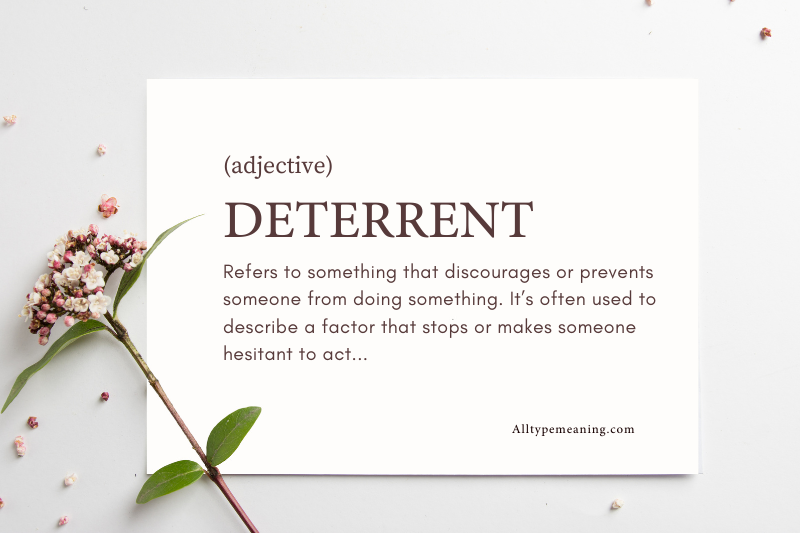
At its core, a deterrent is something that discourages or prevents an action by instilling fear, doubt, or hesitation. Think of it as life’s “pause button”—it makes you think twice before doing something. The deterrent meaning comes from the Latin word deterrere, which means “to frighten away.” So, whether it’s a law, a warning sign, or even a stern look from your mom, a deterrent’s job is to say, “Maybe don’t do that.”
Breaking It Down with Examples
Let’s make this fun. Imagine you’re eyeing a cookie jar, but your roommate says, “Touch those, and you’re doing dishes for a month!” That threat? It’s a deterrent. Or picture a “Trespassers Will Be Prosecuted” sign—yep, that’s a deterrent too, designed to keep you from wandering onto private property.
In deterrent meaning in Hindi, you’d call it “निवारक” (nivaarak), which carries the same vibe of stopping something before it starts. Similarly, in deterrent meaning in Tamil, it’s “தடுப்பு” (taduppu), and in deterrent meaning in Telugu, it’s “నిరోధకం” (nirodhakam). No matter the language, the idea is universal: deter = stop in its tracks.
Expert Insight: Dr. Jane Smith, a behavioral psychologist, explains, “Deterrents work by tapping into our fear of consequences—whether it’s punishment, shame, or loss. They’re like mental speed bumps, slowing us down before we act impulsively.”
Types of Deterrents: From Fines to Fences
Deterrents come in all shapes and sizes, and they’re not just about laws or scary signs. Let’s explore the major types with a dash of humor.
1. Legal Deterrents: The Law’s Way of Saying “Nope”
In the world of law, a deterrent is all about preventing crime. The deterrent meaning in law refers to punishments or laws designed to scare people away from breaking the rules. For example, hefty fines for speeding or jail time for theft are classic legal deterrents.
-
Example: In deterrent meaning in Hindi with example, a fine for littering (जुर्माना, jurmana) stops people from tossing trash on the streets.
Fun Fact: Studies show that certainty of punishment (knowing you’ll get caught) is a stronger deterrent than the severity of the punishment. So, a guaranteed $50 fine might work better than a rare $500 one.
Stats: According to a 2023 study by the National Institute of Justice, 68% of people avoid minor crimes due to fear of legal consequences.
2. Physical Deterrents: Spikes, Fences, and Angry Dogs
Physical deterrents are the “don’t even think about it” of the deterrent world. Think barbed wire, security cameras, or even a “Beware of Dog” sign (whether there’s a dog or not). The visual deterrent meaning is all about making you hesitate with something tangible.
-
Example: In deterrent meaning in Malayalam with example, a spiky fence (വേലി, veli) around a garden keeps stray goats from munching on plants.
Note: Ever seen those fake security cameras? They’re cheap, sneaky, and surprisingly effective at deterring would-be troublemakers.
3. Psychological Deterrents: Mind Games That Work
These are the sneaky ones. Psychological deterrents play with your emotions—fear, guilt, or even social pressure. For instance, a “Shoppers Are Watched” sign in a store might make you think twice about pocketing that candy bar.
-
Example: In deterrent meaning in Bengali, the word “প্রতিরোধক” (pratirodhak) might describe a teacher’s stern glare that stops a student from cheating.
Expert Insight: Dr. Rajesh Kumar, a criminologist, notes, “Social deterrents, like the fear of public shaming, can be as powerful as legal ones in tight-knit communities.”
4. Nuclear Deterrents: The Big, Scary Kind
On a global scale, the nuclear deterrent meaning is about countries maintaining nuclear weapons to prevent attacks. It’s like saying, “If you hit me, I’ll hit back harder.” This strategy, known as mutually assured destruction (MAD), has kept major powers from direct conflict since World War II.
-
Example: India’s credible minimum deterrent meaning refers to its policy of maintaining just enough nuclear capability to deter attacks without escalating an arms race.
Fun Fact: The term “credible minimum deterrent” is a diplomatic way of saying, “We’ve got enough firepower to make you regret it, but we’re not overdoing it.”
5. Everyday Deterrents: From Alarm Clocks to Spicy Food
Deterrents aren’t always about crime or war. In daily life, they’re everywhere. That loud alarm clock? It’s a deterrent to oversleeping. Spicy chili in your garden? That’s a feeding deterrent meaning for pests.
-
Example: In deterrent meaning in Kannada, “ತಡೆಗಟ್ಟುವಿಕೆ” (tadegattuvike) might describe a bitter spray on plants to keep bugs away.
Note: Ever tried eating a ghost pepper? That burn is nature’s way of saying, “Maybe stick to carrots.”
Deterrents in Different Languages: A Global Spin
The concept of deterrence is universal, but it’s fun to see how it translates across cultures. Here’s a quick look at deterrent meaning in various Indian languages:
-
Deterrent meaning in Hindi: निवारक (nivaarak) – Think of a speed bump stopping reckless drivers.
-
Deterrent meaning in Tamil: தடுப்பு (taduppu) – Like a locked gate keeping intruders out.
-
Deterrent meaning in Telugu: నిరోధకం (nirodhakam) – A warning sign for trespassers.
-
Deterrent meaning in Marathi: प्रतिबंधक (pratibandhak) – A fine for illegal parking.
-
Deterrent meaning in Malayalam: തടസ്സം (tadassam) – A fence to protect crops.
-
Deterrent meaning in Bengali: প্রতিরোধক (pratirodhak) – A teacher’s warning to stop talking in class.
-
Deterrent meaning in Punjabi: ਰੋਕਥਾਮ (roktham) – A “No U-turn” sign.
-
Deterrent meaning in Gujarati: નિવારક (nivaarak) – A lock on a diary to keep it private.
Each language captures the essence of stopping or preventing, but the cultural context adds unique flavor. For instance, in deterrent meaning in Tamil with example, a “தடுப்பு” might be a warning bell in a temple to keep visitors respectful.
How Deterrents Shape Behavior: The Psychology Behind It
Why do deterrents work? It’s all about human nature. We weigh risks and rewards before acting (well, most of us do). Deterrents tip the scale toward “not worth it.” Here’s how:
-
Fear of Consequences: Whether it’s a fine, jail time, or just a scolding, the threat of punishment makes us pause.
-
Social Pressure: Nobody wants to be the person caught breaking the rules. Shame is a powerful deterrent.
-
Cost-Benefit Analysis: If the risk (e.g., getting caught) outweighs the reward (e.g., free cookies), we’re less likely to act.
Stats: A 2022 Pew Research study found that 73% of people are deterred from minor offenses (like jaywalking) when they see visible enforcement, like police patrols.
Example: In deterrent meaning in Malayalam with example, a shopkeeper might use a loud alarm (തടസ്സം, tadassam) to deter shoplifters, playing on their fear of being caught.
Real-World Applications: Deterrents in Action
Deterrents aren’t just theory—they’re everywhere. Let’s look at some practical examples:
-
Abuse Deterrent Meaning: In pharmaceuticals, “abuse-deterrent” drugs are designed to prevent misuse. For example, some painkillers are formulated to be hard to crush or dissolve, deterring abuse.
-
Environmental Deterrents: Farmers use feeding deterrent meaning tactics like bitter sprays to keep animals from eating crops.
-
Cybersecurity: Strong passwords and two-factor authentication act as deterrents to hackers.
For more on how deterrents work in cybersecurity, check out Kaspersky’s guide on online safety.
Challenges and Limits of Deterrents
Deterrents aren’t foolproof. Here’s why they sometimes fail:
-
Desperation Overrides Fear: If someone’s desperate enough, no fine or fence will stop them.
-
Lack of Enforcement: A “No Parking” sign is useless if nobody checks.
-
Overconfidence: Some people think they won’t get caught (spoiler: they often do).
Expert Insight: Criminologist Dr. Priya Sharma says, “Deterrents work best when they’re visible, consistent, and credible. A threat with no follow-through is like a dog that doesn’t bark.”
Conclusion: The Power of Pause
The deterrent meaning is all about prevention through persuasion—whether it’s a law, a sign, or a spicy spray. From the deterrent meaning in Hindi (निवारक) to the deterrent meaning in Tamil (தடுப்பு), this concept shapes our world in big and small ways. It’s the reason we don’t speed (usually), don’t trespass (hopefully), and think twice before eating that questionable chili.
By understanding deterrents, we gain insight into human behavior and how societies maintain order. So, next time you see a “Beware” sign or hear a warning, give a nod to the humble deterrent—it’s just doing its job, keeping the world in check.
FAQs: Your Burning Questions Answered
Q: What is the deterrent meaning in English?
A: A deterrent is something that discourages or prevents an action by creating fear, doubt, or hesitation. Think fines, warning signs, or even a stern look.
Q: How does the deterrent meaning in law work?
A: In law, a deterrent is a punishment (like a fine or jail time) designed to prevent people from committing crimes by making them fear the consequences.
Q: What’s the deterrent meaning in Hindi with example?
A: In Hindi, deterrent is “निवारक” (nivaarak). Example: A fine for littering deters people from throwing trash on the road.
Q: What’s a nuclear deterrent?
A: A nuclear deterrent is a country’s nuclear arsenal used to prevent attacks by threatening retaliation. It’s like a global “don’t mess with me.”
Q: Can deterrents fail?
A: Yes, if they’re not enforced, not credible, or if someone’s too desperate to care, deterrents lose their power.
Thank You: Thanks for reading! Check out our previous blog on Nebulous Meaning – Explained in a Simple Way