
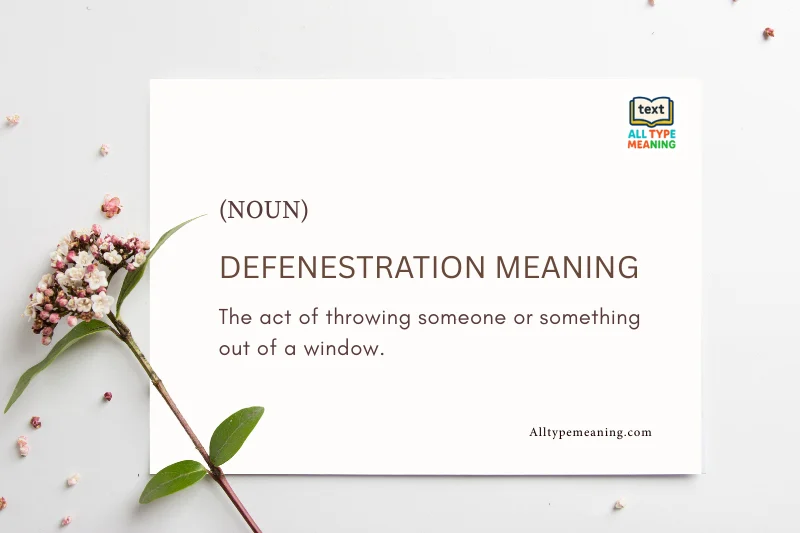
Have you ever pondered the defenestration meaning and the reason behind the existence of this unusual term? 🤔 You are not alone! This intriguing word has piqued the interest of students, history buffs, and language enthusiasts around the globe. The definition of defenestration extends well beyond a mere dictionary entry – it signifies some of the most dramatic events in human history.
Whether you encountered this term in a history book, overheard it in conversation, or came across it during your studies, grasping the meaning of defenestration will enhance your vocabulary and historical understanding. Let us explore this enthralling word that intertwines violence, politics, and gravity in the most literal way!
Historical Statistics of Famous Defenestrations
| Event | Year | Location | Victims | Political Impact |
|---|---|---|---|---|
| First Defenestration of Prague | 1419 | Prague Castle | 7 councilors | Started Hussite Wars |
| Second Defenestration of Prague | 1618 | Prague Castle | 3 officials | Triggered Thirty Years’ War |
| Third Defenestration of Prague | 1948 | Prague | Jan Masaryk | Communist takeover |
| Various Medieval Cases | 1000-1500 | Europe | 50+ documented | Local political changes |
What Does Defenestration Mean? The Complete Definition
To define defenestration, we must break down this impressive word into its core components. The defenestration meaning comes from the Latin word “fenestra,” which means window, combined with the prefix “de-” meaning “from” or “away from.”
Defenestration definition: The act of throwing someone or something out of a window, typically from a considerable height.
While the literal meaning seems straightforward, defenestration carries much deeper historical and cultural significance. It’s not just about tossing objects through windows – it represents a dramatic form of execution, political rebellion, or punishment that has shaped history in remarkable ways! 💫
The Etymology Behind This Powerful Word
The term “defenestration” didn’t exist until the 17th century, coined specifically to describe the infamous Prague incidents. Before this, people simply called it “throwing someone out of a window” – but historians needed a more sophisticated term for such a significant political act.
Interestingly, while defenstration (note the missing ‘e’) is sometimes seen as an alternative spelling, the correct form is defenestration with the ‘e’ included. This distinction matters for proper usage and academic writing! 📚
Historical Examples: When Defenestration Changed the World
The Prague Defenestrations: Europe’s Most Famous Window Incidents
Prague holds the unfortunate distinction of being the defenestration capital of the world, with three major incidents that shaped European history:
1419 – The First Defenestration of Prague 🗡️ During the Hussite revolution, angry Czech protesters stormed Prague’s New Town Hall and threw seven Catholic councilors out of the windows. This event sparked the Hussite Wars, which lasted for decades and fundamentally changed religious politics in Central Europe.
1618 – The Second Defenestration of Prague ⚔️ Protestant Bohemian nobles threw two Catholic Habsburg officials and their secretary from Prague Castle windows. Remarkably, all three survived the 70-foot fall, landing in a pile of manure! This incident triggered the devastating Thirty Years’ War, one of Europe’s most destructive conflicts.
1948 – The Third Defenestration of Prague 🕊️ Foreign Minister Jan Masaryk was found dead below his bathroom window during the Communist coup. Whether it was suicide, murder, or accident remains debated, but it symbolized Czechoslovakia’s tragic fall to Communist rule.
Medieval Justice and Window Punishment
During medieval times, defenestration served as both execution method and symbolic punishment. Castle dwellers often used this method to dispose of traitors, thieves, or political enemies. The height advantage made it particularly effective – and dramatic! 🏰
Modern Usage: How to Use Defenestration in Today’s Language
Literary and Academic Applications
The defenestration meaning is often used metaphorically by modern writers and scholars to describe:
- Political purges: “The CEO’s defenestration of the entire marketing team shocked employees” 💼
- Sudden removals: “The candidate’s defenestration from the race surprised political observers”
- Dramatic departures: “Her defenestration from the company board made headlines”
Educational Context and Student Learning
For students learning vocabulary, defenestration represents an excellent example of:
- Historical terminology: Understanding how specific words develop from historical events 📝
- Latin roots: Exploring how ancient languages influence modern English
- Context clues: Learning to understand complex words through their components
Teachers often use this word to demonstrate how history, language, and culture interconnect in fascinating ways!
Cultural Impact: Defenestration in Art, Literature, and Popular Culture
Artistic Representations
The defenestration meaning has inspired artists throughout history, who depicted famous defenestrations in paintings, sculptures, and illustrations. These works highlight the dramatic nature of such events, capturing both the terror of victims and the determination of perpetrators. 🖼️
Literary References
Famous authors have referenced defenestration in various works:
- Historical novels often feature Prague incidents as pivotal plot points
- Mystery writers use the concept for dramatic murder scenes
- Political satirists employ it metaphorically for character removal
Modern Media and Entertainment
Today’s movies, TV shows, and video games occasionally feature defenestration scenes, usually for dramatic effect or dark humor. The word itself has become shorthand for “dramatic removal” in business and political commentary! 🎬
Fun Facts and Trivia About Defenestration
Surprising Statistics and Records
- Survival rate: Historically, about 30% of defenestration victims survived due to various factors like landing surfaces, clothing acting as parachutes, or lower window heights ✨
- Legal status: In some medieval jurisdictions, defenestration was an official execution method with specific protocols
- Architectural influence: Some castle designs included “murder holes” and strategic window placements for defensive defenestration
Language Connections
The concept exists in other languages too:
- German: “Fenstersturz” (window fall)
- French: “Défenestration” (same spelling)
- Italian: “Defenestrazione”
- Spanish: “Defenestración”
This linguistic similarity shows how the Prague incidents influenced European vocabulary across cultures! 🌍
Conclusion:
The term Defenestration Meaning , which originates from the Latin word fenestra meaning window, refers to the act of throwing an individual or object out of a window. This act often symbolizes significant political or historical events. Notable instances include the Prague Defenestrations of 1419, 1618, and 1948, which instigated wars and political turmoil. In addition to its literal interpretation, the term has evolved to be used metaphorically to describe abrupt removals in the realms of politics, business, or literature. For more interesting word insights, don’t miss our article on poppycock meaning for a deeper dive into another unique term.
Frequently Asked Questions
1. What is the exact defenestration meaning?
Defenestration means the act of throwing someone or something out of a window. It comes from Latin “fenestra” (window) and typically refers to doing this deliberately, often from a significant height.
2. How do you pronounce defenestration correctly?
The correct pronunciation is “dee-fen-uh-STRAY-shun” with emphasis on the fourth syllable. The ‘e’ after ‘def’ is pronounced like “eh.”
3. What’s the difference between defenestration and defenstration?
Defenestration (with the ‘e’) is the correct spelling. “Defenstration” is a common misspelling that should be avoided in formal writing.
4. Are there any famous survivors of defenestration?
Yes! The most famous survivors were the two Habsburg officials thrown from Prague Castle in 1618. They survived a 70-foot fall by landing in a manure pile.
5. Is defenestration used metaphorically in modern language?
Absolutely! Today, people use “defenestration” metaphorically to describe sudden removal from positions, organizations, or situations, especially in business and politics.
Explore more word meanings and vocabulary insights at All Type Meaning.