Understanding feasible meaning starts with a simple question: what makes something truly achievable? 🤔 This powerful word appears everywhere – from business meetings to academic papers, from daily conversations to important decisions. Grasping the complete feasible meaning is your key to clearer, more professional communication.
Whether you’re a student preparing for competitive exams, a working professional drafting proposals, or simply someone curious about expanding your vocabulary, mastering “feasible” will elevate your language skills instantly. In today’s fast-paced world, knowing when something is truly feasible can save time, money, and effort.
This complete guide breaks down everything you need to know about feasible meaning in simple, easy-to-understand language. We’ll explore definitions, translations in multiple Indian languages, real-world examples, and expert tips that will make you confident in using this essential word. Get ready to transform from confused to completely confident! 🚀
What Does “Feasible” Actually Mean? 📖
The word “feasible” comes from the French word “faisable,” which means “doable” or “possible.” In simple terms, when we say something is feasible, we mean it can be done successfully with the available resources, time, and circumstances.
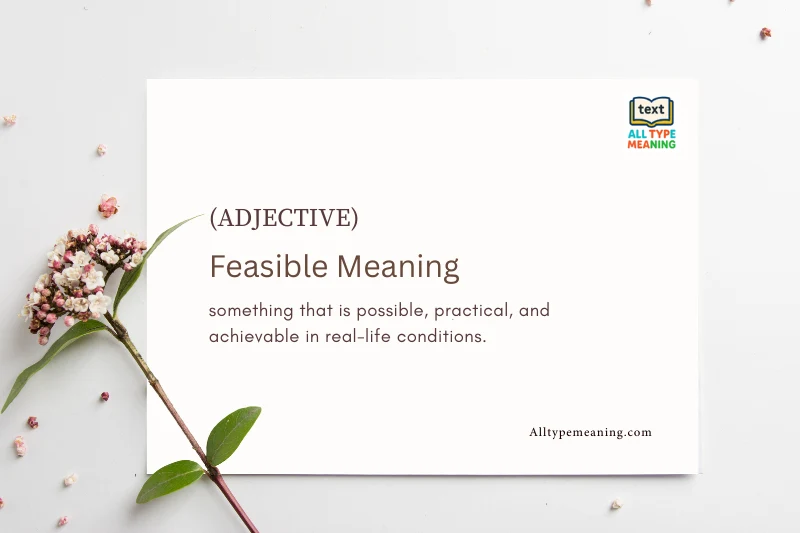
Core Definition: Feasible means something that is possible, practical, and achievable within given constraints.
Real-Life Examples of Feasible:
- ✅ “It’s feasible to complete this project within two weeks”
- ✅ “The new business plan seems feasible given our budget”
- ✅ “Is it feasible to travel to Japan this summer?”
What Makes Something Feasible?
For something to be considered feasible, it must meet these criteria:
- Practically possible – It can actually be done
- Resource-available – You have what you need to do it
- Time-appropriate – There’s enough time to complete it
- Cost-effective – The benefits outweigh the costs
Feasible Meaning in Different Indian Languages 🇮🇳
Understanding feasible meaning in various Indian languages helps millions of students and professionals communicate better. Let’s explore how this important word translates across different regions:
Feasible Meaning in Hindi 🕉️
फिजिबल (Feasible) का हिंदी में अर्थ:
- व्यावहारिक (Vyavaharik) – Practical
- संभव (Sambhav) – Possible
- करने योग्य (Karne Yogya) – Doable
- साध्य (Sadhya) – Achievable
Example in Hindi: “यह योजना व्यावहारिक और संभव है।”
Feasible Meaning in Tamil 🌴
தமிழில் Feasible பொருள்:
- சாத்தியமான (Sathiyamana) – Possible
- நடைமுறைக்குரிய (Nadaimuraikkuriya) – Practical
- செய்யக்கூடிய (Seyyakoodiya) – Doable
Feasible Meaning in Telugu 🌺
తెలుగులో Feasible అర్థం:
- సాధ్యమైన (Sadhyamaina) – Possible
- ఆచరణీయమైన (Acharaneeyamaina) – Practical
- చేయదగిన (Cheyadagina) – Doable
Feasible Meaning in Bengali 🐅
বাংলায় Feasible এর অর্থ:
- সম্ভব (Shombhob) – Possible
- ব্যবহারিক (Byabaharik) – Practical
- করণীয় (Koroneeyo) – Doable
Feasible Meaning in Marathi 🦁
मराठीत Feasible चा अर्थ:
- शक्य (Shakya) – Possible
- व्यावहारिक (Vyavaharik) – Practical
- साध्य (Sadhya) – Achievable
Feasible Meaning in Kannada 🌸
ಕನ್ನಡದಲ್ಲಿ Feasible ಅರ್ಥ:
- ಸಾಧ್ಯವಾದ (Sadhyavada) – Possible
- ಪ್ರಾಯೋಗಿಕ (Prayogika) – Practical
- ಮಾಡಬಹುದಾದ (Madabahudata) – Doable
Common Usage and Context of “Feasible” 💼
Understanding when and how to use “feasible” correctly will boost your communication skills tremendously! Let’s explore various contexts where this word shines:
Business and Professional Context 📊
In the corporate world, “feasible” is frequently used in:
- Project planning: “The marketing campaign is feasible within our Q3 budget”
- Business proposals: “This expansion plan appears highly feasible”
- Strategic decisions: “We need to evaluate if this merger is feasible”
Academic and Educational Context 📚
Students often encounter “feasible” in:
- Research papers: “The study methodology is feasible for undergraduate students”
- Thesis planning: “Is your research topic feasible within the given timeframe?”
- Project submissions: “The proposed experiment is scientifically feasible”
Daily Life Context 🏠
In everyday conversations:
- Travel planning: “Is it feasible to visit five countries in two weeks?”
- Home improvement: “Renovating the kitchen seems feasible this year”
- Personal goals: “Learning a new language in six months is definitely feasible”
Technical and Scientific Context 🔬
In technical fields:
- Engineering: “The bridge design is structurally feasible”
- Software development: “This feature is technically feasible but resource-intensive”
- Medical research: “The clinical trial protocol is ethically and practically feasible”
Synonyms and Antonyms of “Feasible” 🔄
Powerful Synonyms for “Feasible”:
- Achievable – Can be accomplished
- Practical – Sensible and realistic
- Viable – Capable of working successfully
- Workable – Capable of producing the desired result
- Realistic – Having a sensible view of what can be achieved
- Attainable – Able to be reached or achieved
- Possible – Able to be done or achieved
- Doable – Within one’s powers; feasible
Antonyms (Opposite Words):
- Impossible – Cannot be done
- Impractical – Not sensible or realistic
- Unworkable – Not able to function or succeed
- Unattainable – Unable to be reached
- Unrealistic – Not practical or achievable
- Unfeasible – Not possible to do easily
Using Synonyms in Sentences:
- Original: “The project is feasible”
- Alternative 1: “The project is achievable”
- Alternative 2: “The project is viable”
- Alternative 3: “The project is workable”
Advanced Tips for Using “Feasible” Like a Pro ⭐
Tip 1: Consider the Context
Always match the formality level:
- Formal: “The proposal appears feasible upon preliminary analysis”
- Casual: “Yeah, that plan sounds totally feasible!”
Tip 2: Add Qualifying Words
Make your usage more precise:
- “Highly feasible” – Very possible
- “Barely feasible” – Just possible
- “Completely feasible” – Entirely possible
- “Economically feasible” – Financially viable
Tip 3: Common Collocations
Learn these natural word combinations:
- Feasible solution
- Feasible alternative
- Feasible option
- Feasible plan
- Feasible approach
- Feasible strategy
Tip 4: Avoid Common Mistakes ❌
Wrong: “This is very much feasible” Correct: “This is highly feasible” or “This is quite feasible”
Wrong: “It’s not feasible possible” Correct: “It’s not feasible” or “It’s not possible”
Conclusion: Master the Art of Using “Feasible” 🎯
Understanding Feasible Meaning opens doors to clearer, more professional communication. Whether you’re writing academic papers, business reports, or having casual conversations, this versatile word adds precision and sophistication to your language.
Remember these key takeaways:
- ✨ Feasible means practically possible and achievable
- 🌍 It translates meaningfully across multiple Indian languages
- 💼 It’s essential in professional, academic, and daily contexts
- 🎯 Using it correctly demonstrates advanced language skills
Start incorporating “feasible” into your vocabulary today! Practice using it in different contexts, and watch your communication skills soar to new heights. After all, becoming a better communicator is definitely feasible with the right guidance and practice! For more insights into related concepts, don’t miss our guide on Plausible Meaning another powerful word that enhances clarity in communication.🚀✨
Frequently Asked Questions (FAQ) ❓
1. Q: What’s the difference between “feasible” and “possible”?
A: While both words indicate something can happen, “feasible” emphasizes practicality and resource availability. “Possible” is broader – something might be theoretically possible but not practically feasible. For example, traveling to Mars is possible (we have the technology) but not feasible for most people (due to cost and accessibility). 🚀
2. Q: Can “feasible” be used for people?
A: Generally, no. “Feasible” describes plans, ideas, or projects rather than people. Instead of saying “He is feasible for the job,” say “He is suitable for the job” or “Hiring him is feasible within our budget.” However, you could say “His appointment is feasible.” 👥
3. Q: Is there a difference between “feasible” and “viable”?
A: Yes! “Feasible” focuses on whether something CAN be done practically, while “viable” emphasizes whether something can work successfully long-term. A business plan might be feasible (you have resources to start) but not viable (it won’t be profitable). Both are often used together for comprehensive evaluation. 💡
4. Q: How do I use “feasible” in formal writing?
A: In formal contexts, use “feasible” with supporting evidence: “Based on our resource analysis, the project timeline appears feasible.” Avoid casual expressions like “totally feasible” or “super feasible.” Instead, use “highly feasible,” “entirely feasible,” or “completely feasible” for emphasis. 📝
5. Q: What’s the noun form of “feasible”?
A: The noun form is “feasibility.” Example: “We need to conduct a feasibility study before proceeding with the project.” This is commonly used in business and academic contexts to describe detailed evaluations of whether something can work practically and economically. 📊
👉 Explore more insightful word guides like Feasible Meaning only on All Type Meaning your trusted hub for every type of meaning explained clearly!