Plausible Meaning — have you ever come across this word and wondered what it really means? Whether you’re a student preparing for exams, a professional improving your vocabulary, or someone curious about English language nuances, understanding the plausible meaning is essential for effective communication.
In this comprehensive guide, we’ll explore everything about the word “plausible” from its basic definition to its usage in different contexts, along with translations in multiple Indian languages. Let’s dive into this fascinating word that appears frequently in academic texts, news articles, and everyday conversations! ✨
What Does Plausible Actually Mean? 🎯
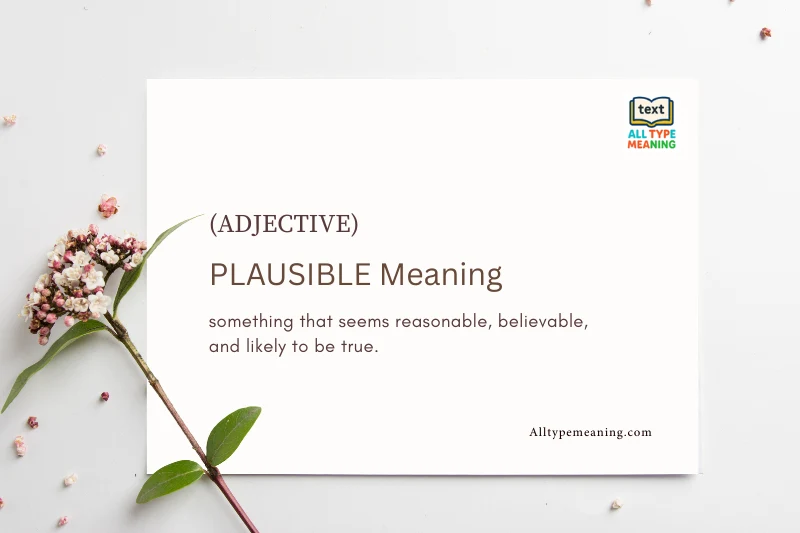
The word “plausible” comes from the Latin word “plausibilis,” which means “worthy of applause.” In modern English, plausible refers to something that seems reasonable, believable, or likely to be true, even though it may not be proven yet.
Simple Definition:
Plausible = Something that sounds reasonable or believable 💡
When we say something is plausible, we mean:
- It makes sense logically 🧠
- It could possibly be true
- It’s believable based on available evidence
- It’s not obviously false or impossible
Example in Context:
The student gave a plausible explanation for being late to class.
This means the explanation sounded reasonable and believable, even if the teacher couldn’t verify it immediately.
Plausible Meaning in Different Indian Languages 🌏
Understanding the plausible meaning in your native language can help you grasp the concept better. Here are translations in popular Indian languages:
🇮🇳 Plausible Meaning in Hindi:
- मुमकिन (Mumkin) – Possible
- विश्वसनीय (Vishwasniya) – Believable
- तर्कसंगत (Tarkasangat) – Logical
- संभावित (Sambhavit) – Probable
Example: “उसकी कहानी काफी मुमकिन लग रही थी।” (His story seemed quite plausible.)
🏛️ Plausible Meaning in Tamil:
- நம்பத்தக்க (Nambathakka) – Believable
- சாத்தியமான (Saathiyamaana) – Possible
- நியாயமான (Niyayamaana) – Reasonable
Example: “அவரது விளக்கம் நம்பத்தக்கதாக இருந்தது।” (His explanation was plausible.)
🎭 Plausible Meaning in Marathi:
- विश्वसनीय (Vishwasniya) – Trustworthy
- शक्य (Shakya) – Possible
- तर्कसंगत (Tarkasangat) – Logical
Example: “तिचे कारण अगदी विश्वसनीय वाटले।” (Her reason seemed quite plausible.)
🎨 Plausible Meaning in Bengali:
- বিশ্বাসযোগ্য (Bisshashyogyo) – Credible
- সম্ভাব্য (Shombhabyo) – Probable
- যুক্তিসঙ্গত (Juktishongoto) – Reasonable
Example: “তার ব্যাখ্যাটি খুবই বিশ্বাসযোগ্য ছিল।” (His explanation was very plausible.)
🎪 Plausible Meaning in Telugu:
- నమ్మదగిన (Nammadagina) – Trustworthy
- సాధ్యమైన (Sadhyamaina) – Possible
- తార్కిక (Thaarkika) – Logical
Example: “అతని వివరణ చాలా నమ్మదగినదిగా అనిపించింది।” (His explanation seemed very plausible.)
How to Use Plausible in Different Contexts 📝
Understanding the plausible meaning is just the first step. Let’s explore how to use this versatile word in various situations:
1. Academic Writing 📚
In essays and research papers:
- The theory provides a plausible explanation for climate change effects.
- Scientists found the hypothesis plausible but requiring further investigation.
2. Business Communication 💼
In professional settings:
- The marketing team presented a plausible strategy for increasing sales.
- Your proposal sounds plausible, but we need to review the budget.
3. Daily Conversations 🗣️
In everyday speech:
- That’s a plausible excuse for missing the meeting.
- It’s plausible that traffic caused the delay.
4. News and Media 📺
In journalism:
- Experts consider the government’s explanation plausible.
- The witness provided a plausible account of the incident.
Common Synonyms and Antonyms of Plausible 🔄
Synonyms (Similar Words):
- Believable – Easy to believe 😊
- Credible – Worthy of belief
- Reasonable – Based on good sense
- Feasible – Possible to do
- Probable – Likely to happen
- Convincing – Able to persuade
- Logical – Based on clear thinking
Antonyms (Opposite Words):
- Implausible – Not believable 😕
- Incredible – Hard to believe
- Unreasonable – Not based on good sense
- Impossible – Cannot happen
- Illogical – Not making sense
- Unconvincing – Not persuasive
- Doubtful – Uncertain
Memory Trick 🧠:
Think of “Plausible” as “Possibly Likely And Understandable Scenario In Believable Language Explanation”
Plausible vs. Similar Words: Key Differences 🔍
Many students confuse “plausible” with similar words. Let’s clear up the confusion!
Plausible vs. Possible:
- Possible = Can happen (but may be unlikely)
- Plausible = Seems reasonable and believable
Example:
- “It’s possible aliens exist.” (Could be true, but no strong evidence)
- “It’s plausible that it will rain tomorrow.” (Weather forecast supports this) ☔
Plausible vs. Probable:
- Probable = Very likely to happen (high chance)
- Plausible = Seems believable (reasonable chance)
Example:
- “It’s probable she’ll pass the exam.” (Strong indicators suggest success)
- “Her study plan seems plausible for success.” (The plan makes sense)
Plausible vs. Credible:
- Credible = Trustworthy source or evidence
- Plausible = Believable explanation or story
Example:
- “He’s a credible witness.” (Trustworthy person)
- “His testimony is plausible.” (Story makes sense) ⚖️
Real-World Examples and Practice Exercises 💪
Let’s practice using Plausible Meaning with real-world scenarios:
Scenario 1: School Setting 🏫
Situation: A student arrives 30 minutes late to class.
Plausible excuses:
- “The bus broke down on the way.” ✅
- “I had a medical emergency.” ✅
- “Traffic was unusually heavy.” ✅
Implausible excuses:
- “Aliens abducted me.” ❌
- “I forgot how to walk.” ❌
- “My house moved to another city.” ❌
Scenario 2: Workplace 💼
Situation: An employee explains why a project is delayed.
Plausible reasons:
- “We encountered unexpected technical issues.”
- “The client requested major changes mid-project.”
- “Key team members were sick this week.”
Scenario 3: Scientific Research 🔬
Situation: Researchers propose a new theory.
What makes it plausible:
- Based on existing evidence 📊
- Follows logical reasoning
- Can be tested experimentally
- Addresses known problems in current theories
Practice Exercise:
Which of these statements are plausible? 🤔
- “I’m late because I stopped to help an accident victim.”
- “My homework disappeared into a parallel universe.”
- “The computer crashed and I lost my work.”
- “A dragon ate my presentation slides.”
Answers: 1 and 3 are plausible; 2 and 4 are implausible! ✨
Tips for Students: Mastering Plausible in Exams 📖
For Vocabulary Tests:
- Remember: Plausible = Believable + Reasonable 💡
- Practice with sentence formation
- Learn synonyms and antonyms
- Understand context usage
For Essay Writing:
- Use “plausible” when discussing theories or explanations
- “The author presents a plausible argument for renewable energy.”
- “This interpretation seems plausible given the historical context.”
For Reading Comprehension:
- Look for clues about believability
- Check if explanations make logical sense
- Consider available evidence
Memory Techniques: 🧠
- Acronym Method: PLAUSIBLE = Pretty Likely And Understandable Story
- Visual Method: Picture a scale ⚖️ – plausible things balance logically
- Association Method: Link with “applause” (original Latin meaning) – something worth believing gets applause! 👏
Conclusion: Mastering the Art of Plausible Communication 🎯
Understanding plausible meaning is more than just memorizing a definition – it’s about developing critical thinking skills that help you evaluate information, create convincing arguments, and communicate effectively. Whether you’re a student writing essays, a professional presenting ideas, or someone learning English as a second language, mastering this word will significantly enhance your communication skills.
Remember these key points:
- Plausible = Believable + Reasonable ✅
- It’s stronger than “possible” but not as certain as “proven”
- Context matters – what’s plausible in one situation may not be in another
- Practice using it in different scenarios to build confidence
The beauty of language learning lies in understanding nuances like these. When you grasp the plausible meaning in English and your native language, you’re not just expanding vocabulary – you’re developing better analytical and communication skills that will serve you throughout your academic and professional journey! 🌟
If you enjoyed exploring this concept, you might also like learning about the Ubiquitous Meaning, another powerful word that can enrich your vocabulary and understanding of context.
Frequently Asked Questions (FAQs) ❓
1. What is the exact plausible meaning in simple terms?
Answer: Plausible means something that seems believable, reasonable, or likely to be true. If you can say “that makes sense” about something, it’s probably plausible! For example, “I was late because of heavy traffic” is plausible because traffic delays happen commonly. 🚗
2. How do you pronounce “plausible” correctly?
Answer: Plausible is pronounced as “PLAW-zi-buhl” with the stress on the first syllable. The ‘au’ sounds like ‘aw’ in “saw,” and the ending is like “zible.” Practice saying it slowly: PLAW-zi-buhl! 🗣️
3. What’s the difference between plausible and possible?
Answer: While both words suggest something could happen, “possible” just means it’s not impossible, while “plausible” means it’s believable and reasonable. For instance, winning the lottery is possible but may not be plausible for most people’s retirement planning! 💰
4. Can you give plausible meaning in Hindi with examples?
Answer: In Hindi, plausible means “संभावित” (sambhavit) or “विश्वसनीय” (vishwasniya). Example: “उसका बहाना काफी विश्वसनीय था” (His excuse was quite plausible). It indicates something that sounds logical and believable in the given situation. 🇮🇳
5. How is “plausible” used in academic writing?
Answer: In academic writing, “plausible” is used to describe theories, explanations, or arguments that seem reasonable based on available evidence. For example: “The researchers presented a plausible hypothesis for the observed phenomena.” It shows that something is worth considering seriously! 📚
🌟 Learn more about such powerful words and their meanings at All Types Meaning 🌐