
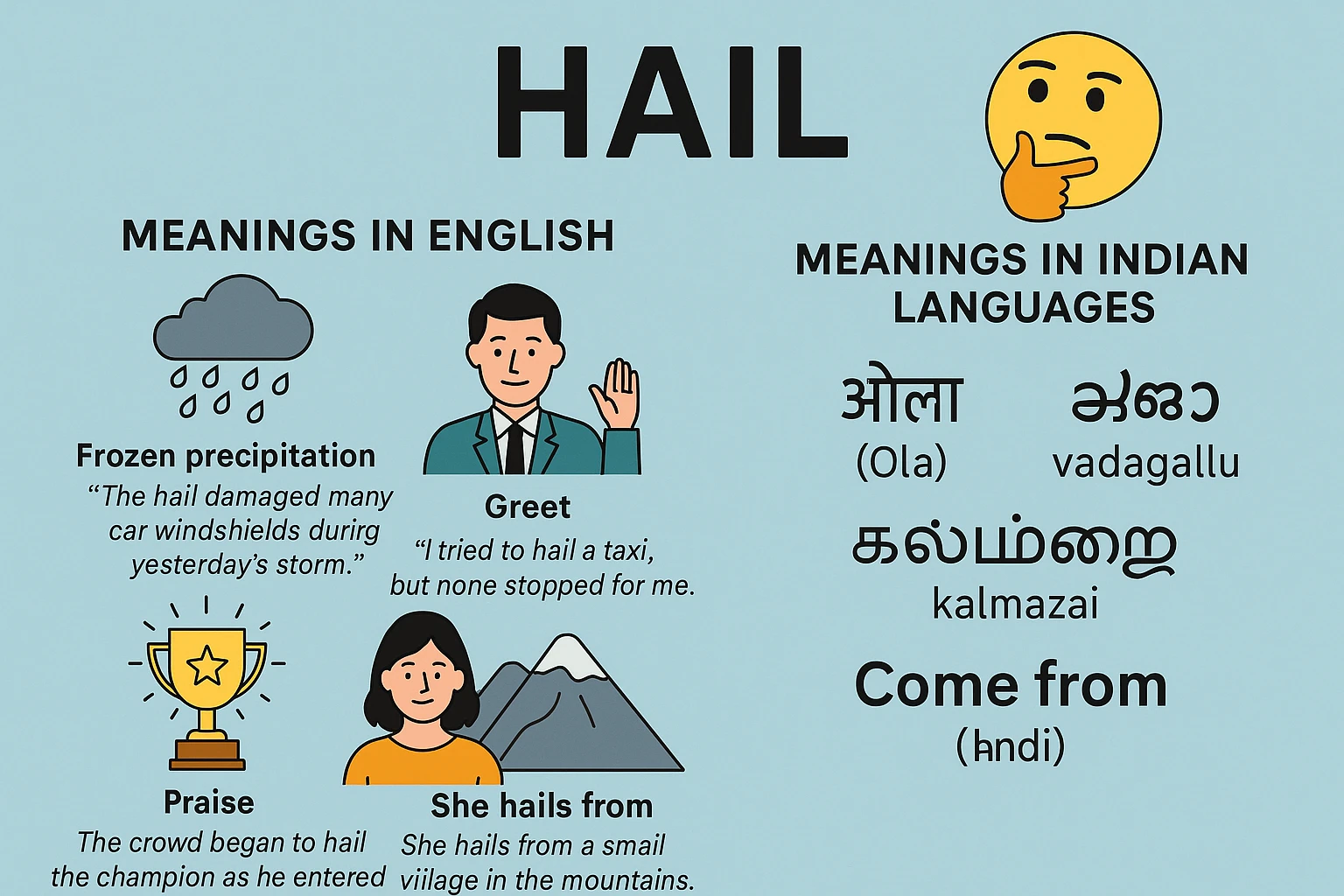
Have you ever wondered about the different hail meaning across various situations? 🤔 This fascinating word carries multiple definitions depending on the context—ranging from icy weather to respectful greetings and even enthusiastic praise.
Whether you’re a student preparing for exams, someone learning English, or simply curious about expanding your vocabulary, this comprehensive guide will help you understand everything about hail meaning and how to use it effectively.
In this article, we’ll explore the various definitions, real-life uses, and translations of hail in multiple Indian languages including Hindi, Telugu, Tamil, Marathi, Bengali, Malayalam, and Kannada. Let’s dive into this complete exploration! ✨
1. Primary Hail Meaning in English 📚
The word “hail” has several distinct meanings in English, making it one of the most versatile words in the language. Here are the main definitions:
Weather-Related Meaning
The most common hail meaning refers to frozen raindrops that fall from the sky during thunderstorms. These ice pellets can range from small pea-sized balls to large golf ball-sized chunks. When meteorologists talk about hailstorms, they’re referring to weather conditions where these frozen precipitation falls heavily.
Example: “The hail damaged many car windshields during yesterday’s storm.” 🚗
Greeting or Salutation Meaning
Another important hail meaning involves greeting or calling out to someone. When you “hail” someone, you’re trying to get their attention or acknowledge them respectfully.
Example: “I tried to hail a taxi, but none stopped for me.” 🚕
Expression of Praise or Honor
The word “hail” also means to praise, acclaim, or honor someone or something. This usage often appears in formal contexts or celebrations.
Example: “The crowd began to hail the champion as he entered the arena.” 🏆
Origin or Source Meaning
When someone asks where you “hail from,” they’re asking about your place of origin or hometown.
Example: “She hails from a small village in the mountains.” 🏔️
2. Hail Meaning in Indian Languages 🇮🇳
Understanding hail meaning in Hindi and other Indian languages is crucial for millions of speakers. Let’s explore how different Indian languages interpret this word:
Hail Meaning in Hindi
In Hindi, hail meaning translates to several words depending on the context:
- ओला (Ola) – for the weather phenomenon of frozen rain
- जयकार (Jaykar) – for expressions of praise or acclaim
- नमस्कार (Namaskaar) – for greeting someone
- आना (Aana) – when referring to origin (hail from)
Example: “कल रात ओले गिरे थे” (Last night it hailed) ❄️
Hail Meaning in Telugu
For Telugu speakers, hail meaning in Telugu includes:
- వడగళ్లు (Vadagallu) – for ice pellets from sky
- జయఘోష (Jayaghosha) – for expressions of victory or praise
- వచ్చిన (Vacchina) – when talking about origin
All hail meaning in Telugu would be “జయజయకారాలు” expressing complete victory or praise.
Hail Meaning in Tamil
In Tamil, hail meaning in Tamil encompasses:
- கல்மழை (Kalmazhai) – literally meaning “stone rain” for hailstones
- வணக்கம் (Vanakkam) – for greeting context
- புகழ்ச்சி (Pugazhchi) – for praise or acclaim
- வந்த (Vantha) – for origin meaning
Hail Meaning in Marathi
Marathi speakers understand hail meaning in Marathi as:
- गारपीट (Gaarpit) – for hailstorm weather
- नमस्कार (Namaskaar) – for greeting someone
- स्तुती (Stuti) – for praise or honor
- येणे (Yene) – for coming from somewhere
Other Indian Languages
- Hail meaning in Bengali: শিলাবৃষ্টি (Shilabrishti) for weather, নমস্কার (Namaskar) for greeting
- Hail meaning in Malayalam: കന്മഴ (Kanmazha) for hailstones, വന്ദനം (Vandanam) for salutation
- Hail meaning in Kannada: ಆಲಿಕಲ್ಲು (Aalikallu) for ice pellets, ನಮಸ್ಕಾರ (Namaskara) for greeting
3. All Hail Meaning and Usage 👑
The phrase “all hail” deserves special attention as it’s commonly used in literature, movies, and formal ceremonies. All hail meaning typically expresses:
Historical and Royal Context
In medieval times and royal settings, “all hail” was used to show respect to kings, queens, or nobility. It’s similar to saying “long live the king” or “glory to the ruler.”
Example: “All hail the new king!” 👑
Modern Usage
Today, all hail meaning has evolved to include:
- Showing extreme respect or admiration
- Acknowledging someone’s achievements
- Expressing loyalty or support
- Being used ironically or humorously
All hail meaning in Telugu (జయజయకారాలు) carries the same respectful and celebratory tone as in English.
Literary and Cultural References
Many famous works use “all hail” including Shakespeare’s plays, fantasy novels, and epic movies. Understanding this phrase helps in appreciating classical literature and modern entertainment. 📖
4. Common Phrases and Expressions with Hail 🗣️
Learning common phrases helps you understand hail meaning in different contexts:
Weather-Related Phrases
- Hailstorm: A severe weather condition with heavy hail
- Hail damage: Destruction caused by falling ice pellets
- Hail-sized: Describing the size of something compared to hailstones
Communication Phrases
- Hail a cab/taxi: Trying to stop a taxi by waving
- Hail someone: Calling out to get attention
- Within hailing distance: Close enough to be heard when called
Origin Phrases
- Hail from: Come from or originate from a place
- Hailing from: Present continuous form of coming from somewhere
Praise Phrases
- Hail as: Recognize or acclaim someone as something
- Hailed for: Praised or recognized for achievements
5. Tips for Using Hail Correctly in Different Contexts 💡
Understanding when and how to use Hail Meaning appropriately is essential for effective communication:
Context Identification
Always identify the context first:
- Weather reports: Use weather-related meaning
- Transportation: Use the calling/summoning meaning
- Formal ceremonies: Use the praise/honor meaning
- Introductions: Use the origin meaning
Cultural Sensitivity
When translating Hail Meaning in Hindi or other Indian languages, consider:
- Regional variations in pronunciation
- Cultural appropriateness of formal vs informal usage
- Religious or traditional contexts that might affect meaning
Grammar Rules
- Hail can be used as both noun and verb
- Past tense is hailed
- Present participle is hailing
- Can be used transitively and intransitively
Common Mistakes to Avoid
- Don’t confuse “hail” with “hell” in pronunciation
- Remember context determines meaning
- Use appropriate translations for different Indian languages
- Understand formal vs informal usage
Conclusion 🎯
Understanding hail meaning in all its forms – from weather phenomena to expressions of praise – opens up a world of communication possibilities. Whether you’re learning hail meaning in Hindi, hail meaning in Telugu, or any other Indian language, the key is recognizing context and cultural appropriateness.
This comprehensive guide covered everything from basic definitions to cultural translations, helping students and language learners master this versatile word. Remember, language learning is a journey, and understanding words like “hail” in multiple contexts and languages makes you a more effective communicator.
Frequently Asked Questions (FAQs) ❓
Q1: What is the most common hail meaning?
A: The most common hail meaning refers to frozen raindrops or ice pellets that fall during thunderstorms. This weather phenomenon is what most people think of when they hear the word “hail.”
Q2: How do you say hail meaning in Hindi?
A: Hail meaning in Hindi depends on context: ओला (Ola) for weather, जयकार (Jaykar) for praise, नमस्कार (Namaskaar) for greeting, and आना (Aana) for origin. The weather meaning is most commonly used.
Q3: What does “all hail” mean and when is it used?
A: All hail meaning is an expression of praise, honor, or respect, traditionally used for royalty or in formal ceremonies. Today it’s also used to show extreme admiration or sometimes ironically. All hail meaning in Telugu is జయజయకారాలు.
Q4: Can “hail” be used as both noun and verb?
A: Yes! Hail meaning includes both grammatical forms. As a noun: “The hail damaged the crops.” As a verb: “I hailed a taxi” or “They hail from Mumbai.” Understanding this versatility is key to using the word correctly.
Q5: What’s the difference between hail meaning in different Indian languages?
A: While the core concepts remain the same, each language has unique terms: hail meaning in Tamil uses கல்மழை (Kalmazhai), hail meaning in Telugu uses వడగళ్లు (Vadagallu), and hail meaning in Marathi uses गारपीट (Gaarpit) for the weather phenomenon. The greeting and praise meanings also vary by language and cultural context.
📖 Strengthen your grip on academic and everyday English by exploring essential terms like Imminent Meaning and how it’s used in urgent situations.
https://shorturl.fm/51knk
https://shorturl.fm/qIgXo
https://shorturl.fm/JSuW4