Have you ever heard someone say “danger is imminent” or “the storm is imminent” and wondered about the imminent meaning behind these phrases? The word “imminent” is commonly used in news, literature, and everyday conversations, but what does it really mean?
In this comprehensive guide, we’ll explore everything you need to know about the word “imminent”—from its basic definition to its usage in different languages.
Whether you’re a student preparing for exams, someone learning English as a second language, or just curious about expanding your vocabulary, this article will help you master the meaning and usage of “imminent.” Let’s dive in! 📖
What Does “Imminent” Mean? The Basic Definition 📝
The word “imminent” is an adjective that describes something that is about to happen very soon. When we say something is imminent, we mean it’s going to occur in the immediate future – usually within minutes, hours, or at most a few days.
Key Characteristics of “Imminent”:
- Timing: Refers to events happening very soon
- Certainty: Suggests the event will definitely happen
- Urgency: Creates a sense of immediacy
- Preparation: Often used as a warning to get ready
Simple Definition:
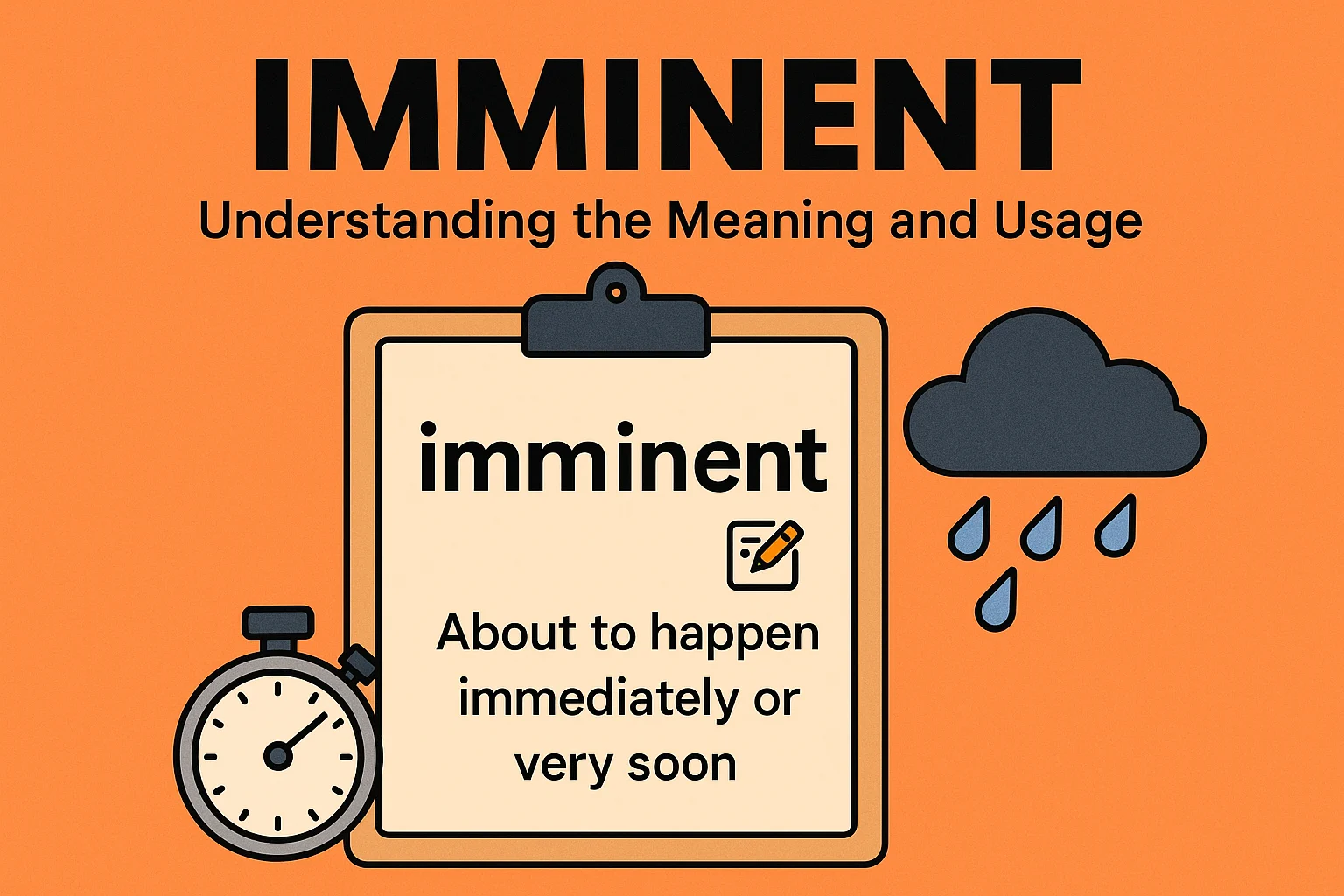
Imminent = About to happen immediately or very soon ⏰
Think of it like this: if you see dark clouds gathering and feel the first drops of rain, you might say “rain is imminent” because it’s clearly about to start pouring any moment.
Etymology and Origin of “Imminent” 📚
Understanding where a word comes from can help us remember its meaning better. The word “imminent” has an interesting history:
- Origin: Latin word “imminere”
- Root breakdown: “im-” (upon) + “minere” (to project or hang over)
- Literal meaning: “hanging over” or “threatening to fall”
- First English use: Around the 16th century
This origin explains why “imminent” often carries a sense of something looming or threatening to happen, like a storm cloud hanging over your head! ☁️
Imminent Meaning in Different Indian Languages 🇮🇳
India’s linguistic diversity means that understanding “imminent” in various regional languages can be incredibly helpful. Here are the translations:
Imminent Meaning in Hindi
Hindi Translation: आसन्न (aasann), निकटस्थ (nikattha), तुरंत होने वाला (turant hone wala)
Example: “बारिश आसन्न है” (Baarish aasann hai) – “Rain is imminent”
Imminent Meaning in Bengali
Bengali Translation: আসন্ন (ashonno), নিকটবর্তী (nikotborti)
Example: “ঝড় আসন্ন” (Jhor ashonno) – “Storm is imminent”
Imminent Meaning in Tamil
Tamil Translation: உடனடி (udanadi), நெருங்கிய (nerungiya)
Example: “மழை உடனடியாக வரும்” (Mazhai udanadiyaga varum) – “Rain is imminent”
Imminent Meaning in Telugu
Telugu Translation: తక్షణమే (takshname), దగ్గరలో (daggaralo)
Example: “వర్షం తక్షణమే వస్తుంది” (Varsham takshname vasthundi) – “Rain is imminent”
Imminent Meaning in Kannada
Kannada Translation: ತಕ್ಷಣದ (takshanaada), ಸಮೀಪದ (sameepa)
Example: “ಮಳೆ ತಕ್ಷಣದಲ್ಲಿ ಬರುತ್ತದೆ” (Male takshanadalli baruttade) – “Rain is imminent”
Common Usage and Examples of “Imminent” 💡
Understanding how to use “imminent” correctly is crucial for effective communication. Here are various contexts where this word appears:
1. Weather and Natural Events 🌦️
- “The weather forecast shows imminent rainfall”
- “Evacuation orders were issued due to imminent flooding”
- “Scientists detected signs of an imminent earthquake”
2. Business and Economics 💼
- “The company announced imminent layoffs”
- “Market analysts predict imminent changes in interest rates”
- “The merger between the two companies is imminent”
3. Health and Medical Contexts 🏥
- “The patient showed signs of imminent recovery”
- “The doctor warned of imminent complications”
- “Imminent surgery was required to save the patient’s life”
4. Technology and Innovation 💻
- “The software update is imminent”
- “Tech experts predict imminent breakthroughs in AI”
- “The launch of the new smartphone is imminent”
5. Politics and Governance 🏛️
- “Political analysts discuss imminent policy changes”
- “The announcement of election results is imminent”
- “Imminent diplomatic negotiations could resolve the crisis”
Important Note About Usage:
“Imminent” is typically used with events that are:
- ✅ Expected to happen soon
- ✅ Somewhat serious or significant
- ✅ Certain to occur
- ❌ Not used for positive casual events (we don’t usually say “imminent celebration”)
Synonyms and Antonyms of “Imminent” 🔄
Synonyms (Similar Words):
- Impending – hanging over threateningly
- Approaching – coming nearer in time
- Forthcoming – about to appear or happen
- Looming – appearing as a vague and threatening shape
- Immediate – happening right now
- Pending – waiting to be dealt with
- Near – close in time
- Close – near in time or space
- At hand – within reach; nearby
- Around the corner – very close in time
Antonyms (Opposite Words):
- Distant – far away in time
- Remote – far away; having little connection
- Unlikely – not likely to happen
- Postponed – delayed to a later time
- Delayed – made to occur later than planned
- Future – time that is to come
- Eventual – happening at an unspecified future time
- Deferred – put off to a later time
Memory Tips 🧠
To remember “imminent”:
- Think of “I’m in it” – you’re in the situation where something is about to happen
- Remember the storm cloud analogy – hanging over and ready to pour
- Associate with urgency and “any minute now”
Grammatical Usage and Sentence Structure 📝
Understanding how to use “imminent” grammatically will help you sound more natural and confident:
As a Predicate Adjective:
- “The arrival of the train is imminent”
- “His promotion seems imminent”
- “The deadline is imminent”
As an Attributive Adjective:
- “We prepared for the imminent storm”
- “The imminent changes will affect everyone”
- “She sensed imminent danger”
Common Phrases with “Imminent” 🔍
To better grasp the Imminent Meaning in real-world contexts, here are some commonly used phrases that highlight its urgency and certainty:
-
Imminent danger – immediate threat
-
Imminent threat – approaching danger
-
Imminent arrival – about to arrive
-
Imminent departure – about to leave
-
Imminent change – change happening soon
-
Imminent collapse – about to fall or fail
These phrases reinforce the imminent meaning as something serious or significant that is expected to happen very soon.
Degrees of Imminence
To better understand the imminent meaning in different contexts, it’s helpful to know that while “imminent” suggests something is about to happen soon, its urgency can be modified with descriptive words:
-
Highly imminent – extremely likely to happen very soon
-
Seemingly imminent – appears to be about to happen, but not certain
-
Potentially imminent – might happen soon, depending on circumstances
These variations help clarify the imminent meaning based on how urgent or likely the situation is.
Common Mistakes to Avoid ❌
- Don’t use with past tense: ❌ “The storm was imminent yesterday” Correct: ✅ “The storm seemed imminent yesterday”
- Don’t overuse: ❌ “My imminent lunch” (too casual) Better: ✅ “My upcoming lunch” or simply “lunch”
- Don’t confuse with ’eminent’:
- Imminent = about to happen
- Eminent = famous or distinguished
Conclusion: Mastering the Word “Imminent” 🎯
Understanding the meaning of “imminent” opens up a world of more precise and effective communication. Whether you’re writing an essay, having a conversation, or reading the news, this word helps you express the urgency and certainty of upcoming events.
Key Takeaways:
- Definition: About to happen very soon ⏰
- Usage: Primarily for significant or serious upcoming events
- Pronunciation: IM-uh-nent 🔊
- Translations: Available in Hindi, Bengali, Tamil, Telugu, and Kannada
- Context: Weather, business, health, technology, and politics
Tips for Remembering “Imminent”:
- Visual: Picture storm clouds hanging overhead ☁️
- Association: Think “I’m in it” – in the moment before something happens
- Practice: Use it in sentences about upcoming events
- Context: Notice how it’s used in news and formal writing
By mastering “imminent,” you’ve added a powerful word to your vocabulary that will serve you well in both academic and professional settings. Keep practicing, and soon using “imminent” will become second nature!
Frequently Asked Questions (FAQs) ❓
1. What is the difference between “imminent” and “immediate”?
Answer: While both words suggest something happening soon, there’s a subtle difference:
- Imminent means “about to happen very soon” (within hours, days, or weeks)
- Immediate means “happening right now” or “without delay”
Examples:
- “The meeting is imminent” (happening in the next few hours)
- “We need immediate action” (right now, without waiting)
2. Can “imminent” be used for positive events?
Answer: While “imminent” can technically be used for any upcoming event, it’s more commonly used for serious, significant, or potentially concerning situations. For positive events, words like “approaching,” “upcoming,” or “forthcoming” sound more natural.
Examples:
- ✅ “The imminent storm worried residents”
- ✅ “Her graduation is approaching” (better than “imminent graduation”)
3. How do you pronounce “imminent”?
Answer: “Imminent” is pronounced as IM-uh-nent 🔊
- IM (like “him” without the ‘h’)
- uh (short vowel sound)
- nent (rhymes with “sent”)
Phonetic: /ˈɪmɪnənt/
4. Is there a difference between “imminent meaning in Hindi” and other regional languages?
Answer: The core meaning remains the same across all languages – “about to happen soon.” However, different languages may have varying connotations:
- Hindi “आसन्न” often carries a formal or literary tone
- Bengali “আসন্ন” is commonly used in both formal and informal contexts
- Tamil “உடனடி” emphasizes immediacy more strongly
- Telugu “తక్షణమే” suggests “right away”
- Kannada “ತಕ್ಷಣದ” implies “without delay”
5. Can I use “imminent” in academic writing?
Answer: Absolutely! “Imminent” is an excellent word for academic and formal writing. It’s precise, professional, and adds sophistication to your vocabulary.
Academic Examples:
- “The research suggests imminent changes in climate patterns”
- “The data indicates an imminent shift in market dynamics”
- “Historical analysis reveals imminent social transformation”
🔗If you’re interested in learning about qualities that help people face imminent challenges, don’t miss our detailed guide on the tenacity meaning—a trait that defines unwavering determination and persistence.
https://shorturl.fm/ySq9F
https://shorturl.fm/qIgXo