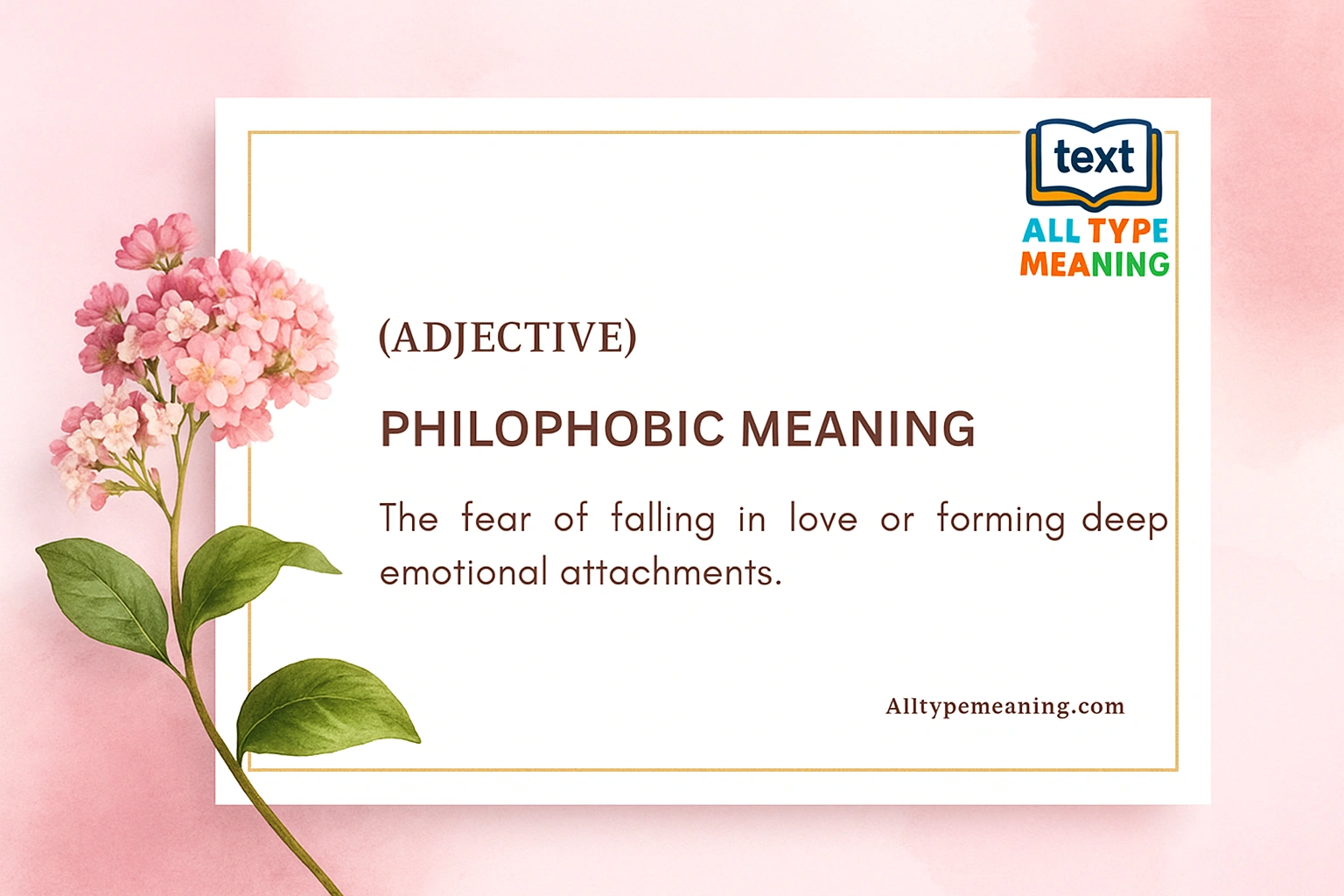
Welcome to All Type Meaning ! The word philophobic meaning refers to someone who fears falling in love or forming deep emotional attachments. In simple terms, a philophobic person avoids relationships not because they dislike love, but because they’re afraid of being hurt or vulnerable. This fascinating word goes beyond psychology—it reflects emotions many people experience in real life.
Understanding such terms helps students expand their vocabulary, professionals communicate with empathy, and language learners connect words with real emotions. In this blog, we’ll explore the complete philophobic meaning, its origin, examples, and how it’s used in daily life—making learning both meaningful and relatable!
Philophobic Meaning: Complete Definition
Philophobic (adjective) refers to a person who experiences philophobia—an irrational, persistent, and overwhelming fear of falling in love or emotional attachment. Someone who is philophobic actively avoids romantic relationships, emotional intimacy, and deep connections with others, not out of preference, but due to genuine anxiety and fear.
Quick Understanding Table
| Aspect | Details |
|---|---|
| Word | Philophobic |
| Pronunciation | fil-oh-FOH-bik (/ˌfɪləˈfoʊbɪk/) |
| Part of Speech | Adjective |
| Meaning | Fear of falling in love or emotional attachment |
| Origin | Greek: Philo (love) + Phobia (fear) |
| Related Terms | Philophobia (noun), Philophobe (person) |
| Symptoms | Avoiding relationships, panic when intimate, emotional walls |
| Causes | Past trauma, heartbreak, childhood issues, low self-esteem |
| Treatment | Therapy (CBT), counseling, gradual exposure |
| Common in | People with past relationship trauma or anxiety |
Pronunciation & Phonetics
- Standard Spelling: Philophobic
- Phonetic Spelling: fil-oh-FOH-bik
- IPA Notation: /ˌfɪləˈfoʊbɪk/
- Part of Speech: Adjective
- Related Noun: Philophobia (the condition itself)
- Related Noun: Philophobe (person with the fear)
Philophobic Meaning in Different Languages
| Language | Meaning/Translation | Example Usage |
|---|---|---|
| English | Fear of falling in love | She is philophobic after her last breakup. |
| Hindi (हिंदी) | प्यार से डरने वाला (pyaar se darne wala) | वह फिलोफोबिक है और रिश्तों से बचता है। |
| Bengali (বাংলা) | ভালোবাসার ভয় (bhalobhasha’r bhôy) | সে ফিলোফোবিক এবং সম্পর্ক এড়িয়ে চলে। |
| Telugu (తెలుగు) | ప్రేమకు భయపడే (premaku bhayapade) | అతను ఫిలోఫోబిక్ మరియు సంబంధాలకు దూరంగా ఉంటాడు। |
| Urdu (اردو) | محبت سے خوفزدہ (mohabbat se khaufzada) | وہ فیلوفوبک ہے اور تعلقات سے گریز کرتا ہے۔ |
| Marathi (मराठी) | प्रेमाची भीती (premachi bhiti) | ती फिलोफोबिक आहे आणि नातेसंबंध टाळते। |
| Malayalam (മലയാളം) | സ്നേഹത്തെ ഭയപ്പെടുന്ന (snehatthe bhayappedunna) | അവൻ ഫിലോഫോബിക് ആണ്, ബന്ധങ്ങൾ ഒഴിവാക്കുന്നു। |
| Punjabi (ਪੰਜਾਬੀ) | ਪਿਆਰ ਤੋਂ ਡਰਨ ਵਾਲਾ (pyar ton daran wala) | ਉਹ ਫਿਲੋਫੋਬਿਕ ਹੈ ਅਤੇ ਰਿਸ਼ਤਿਆਂ ਤੋਂ ਬਚਦਾ ਹੈ। |
| Tamil (தமிழ்) | காதலுக்கு பயப்படுபவர் (kaathalukku payappadubavar) | அவர் பிலோபோபிக், உறவுகளைத் தவிர்க்கிறார். |
Origin & Etymology: Where Does “Philophobic” Come From?
The word philophobic meaning has fascinating Greek roots that reveal its meaning:
- Philo- (φίλος): Greek prefix meaning “love” or “loving”
- -phobia (φόβος): Greek suffix meaning “fear” or “dread”
Combined, these roots create “philophobia”—literally translating to “fear of love.” The adjective form “philophobic” describes someone experiencing this condition.
Historical Context
While the fear of love has existed throughout human history, the clinical term philophobia emerged in psychological literature during the 20th century as mental health professionals began categorizing specific phobias. The term gained popular recognition in the 1990s and 2000s as psychology became more mainstream in public discourse. Today, with increased awareness of mental health, “philophobic” is widely used in both clinical and casual contexts to describe people who struggle with romantic vulnerability.
First Known Use: The term appeared in psychological texts in the early-to-mid 1900s, though it gained mainstream usage much later.
Detailed Usage: Understanding Philophobic in Context
Primary Meanings & Contexts
1. Clinical/Psychological Context 🏥 When used in medical or therapeutic settings, philophobic describes a diagnosable anxiety condition characterized by:
- Intense fear triggered by thoughts of romantic love
- Physical symptoms (rapid heartbeat, sweating, panic attacks)
- Avoidance behaviors that interfere with normal life
- Example: “The therapist diagnosed him as severely philophobic after years of sabotaging relationships.”
2. Casual/Social Context 👥 In everyday conversation, people use philophobic more loosely to describe:
- Someone who consistently avoids commitment
- A person emotionally unavailable after trauma
- Individuals who “run away” when relationships deepen
- Example: “My friend is totally philophobic—she ghosts guys the moment they say ‘I love you.'”
3. Self-Descriptive Context 🪞 Many people identify themselves as philophobic when:
- Recognizing their own patterns of relationship avoidance
- Explaining their emotional walls to potential partners
- Seeking understanding from friends and family
- Example: “I’m philophobic because of my parents’ toxic marriage.”
Grammar Notes
- As an adjective: “He is philophobic.” / “Her philophobic tendencies emerged.”
- Can modify nouns: “philophobic behavior,” “philophobic response,” “philophobic individual”
- Cannot be used as a verb (incorrect: “He philophobics”)
- Related forms:
- Noun: philophobia (“She suffers from philophobia”)
- Noun: philophobe (“He’s a philophobe”)
- Adverb form (rare): philophobically
Common Collocations
Words frequently used with “philophobic”:
- Verbs: become philophobic, seem philophobic, act philophobic, remain philophobic
- Adverbs: deeply philophobic, extremely philophobic, somewhat philophobic, increasingly philophobic
- Phrases: philophobic tendencies, philophobic behavior, philophobic symptoms, philophobic patterns
Synonyms & Antonyms: Similar and Opposite Words
Synonyms
| Synonym | Meaning |
|---|---|
| Commitment-phobic | Afraid of long-term relationship obligations |
| Emotionally unavailable | Unable or unwilling to connect emotionally |
| Love-averse | Having a strong dislike or avoidance of love |
| Romance-resistant | Opposing or avoiding romantic situations |
| Attachment-avoidant | Steering clear of emotional bonds |
| Intimacy-fearing | Frightened of close personal connections |
| Guarded | Cautious and protective of one’s feelings |
| Emotionally detached | Disconnected from emotional experiences |
| Withdrawn | Isolated from emotional or social engagement |
| Closed-off | Not open to emotional vulnerability |
Antonyms
| Antonym | Meaning |
|---|---|
| Philophilic | Loving or attracted to love (rare term) |
| Romantic | Inclined toward love and romance |
| Affectionate | Showing fondness and tenderness |
| Open-hearted | Willing to love and be vulnerable |
| Emotionally available | Ready for intimate connections |
| Commitment-ready | Prepared for serious relationships |
| Loving | Feeling or showing love freely |
| Warm | Emotionally responsive and caring |
| Vulnerable | Open to emotional intimacy |
| Passionate | Showing intense emotional connection |
Words That Look Similar
Be careful not to confuse philophobic with these similar-looking terms:
- Phobic: General term for any fear (not specific to love)
- Bibliophobic: Fear of books
- Philosophic/Philosophical: Related to philosophy (completely different!)
- Philanthropic: Charitable, loving humanity
- Philharmonic: Relating to music and orchestras
- Hydrophobic: Fear of water OR water-repelling (in chemistry)
Pro Tip: The key identifier is “-phil-” (love) + “-phobia” (fear) = fear of love! 💝
Example Sentences: Philophobic in Real-Life Usage
- Clinical Context: “After three failed marriages, David became increasingly philophobic, requiring cognitive behavioral therapy to address his fear of emotional intimacy.” 🏥
- Personal Relationship: “Sarah realized she was philophobic when she broke up with every boyfriend who tried to introduce her to their family.” 💔
- Self-Awareness: “I’m not rude or cold—I’m just philophobic because my first love betrayed me, and I haven’t healed yet.” 🩹
- Social Observation: “Many people in their 30s appear philophobic, but they’re actually just prioritizing career over relationships.” 💼
- Literary/Poetic: “He was a philophobic soul, building walls of stone where windows should have been, fearing the light of love might reveal his vulnerabilities.” 📖
- Advice Column: “Dear Philophobic Partner: Your fear is valid, but you can’t let past hurt prevent future happiness—consider seeking professional help.” 💌
- Comparative: “Unlike her philophobic brother, Maya embraced love openly, believing vulnerability was strength, not weakness.” 🌸
Common Mistakes & Tips: Avoid These Errors!
Spelling Mistakes
- ❌ Philaphobic → ✅ Philophobic
- ❌ Phillobobic → ✅ Philophobic
- ❌ Filosophic → ✅ Philophobic (not philosophic!)
- ❌ Phillophobic → ✅ Philophobic (one ‘l’ in philo)
Grammar Errors
Wrong: “He philophobics every time someone gets close.” Right: “He acts philophobic every time someone gets close.”
Wrong: “She has a philophobic.” Right: “She has philophobia.” (noun form) OR “She is philophobic.” (adjective)
Usage Mistakes
- Don’t overuse clinically: Not everyone avoiding relationships is philophobic—some people simply aren’t interested in dating.
- Don’t stigmatize: Philophobia is a real psychological condition, not a character flaw or personality defect.
- Don’t self-diagnose casually: True philophobia involves significant distress and impairment—casual relationship caution isn’t the same thing.
Quick Tips to Remember
- “PHILO = LOVE” – Think Philadelphia (city of brotherly love)
- “PHOBIA = FEAR” – Like claustrophobia or arachnophobia
- Memory trick: “Phil is afraid of falling, so he’s philophobic about love!”
- One word, not hyphenated: Write “philophobic” not “philo-phobic”
Cultural & Contextual Insight: Philophobia in Society
Psychological Perspective
The philophobic meaning refers to the fear of falling in love or forming deep emotional attachments. Although philophobia isn’t officially listed in the DSM-5 (Diagnostic and Statistical Manual of Mental Disorders), mental health professionals recognize it as a specific phobia under anxiety disorders. It often develops from:
- Past trauma: Betrayal, abandonment, or toxic relationships
- Childhood experiences: Witnessing parents’ bad marriage or divorce
- Low self-esteem: Feeling unworthy of love
- Fear of loss: Avoiding love to prevent future heartbreak
- Attachment disorders: Formed in early childhood
In Popular Culture
Philophobic characters frequently appear in:
- Movies: Protagonists who “don’t do relationships” until they meet “the one”
- TV Shows: Characters like Barney Stinson (How I Met Your Mother) or early Chandler Bing (Friends)
- Music: Songs about emotional walls and fear of vulnerability
- Literature: Romance novels often feature a philophobic character who learns to love
Modern Dating Context
In today’s dating culture:
- Ghosting and breadcrumbing may stem from philophobic tendencies
- Dating apps can enable philophobic behavior (endless options prevent commitment)
- Therapy normalization has made discussing philophobia more acceptable
- Social media creates platforms for philophobic people to find community and support
Regional/Cultural Variations
While the English term “philophobic” is used globally, different cultures have their own expressions:
- Indian culture: “Commitment-phobic” is more common in casual Hindi-English conversation
- Middle Eastern contexts: Often described through religious or family-oriented language
- Western societies: More clinical and psychological framing
- East Asian cultures: May emphasize practical reasons over emotional fears
Tips to Remember Philophobic: Memory Hacks!
Visualization Technique
Picture Phil (a person) standing at the edge of a cliff labeled “LOVE,” too phobic (scared) to jump. Phil-o-phobic = Phil afraid of love!
Word Association Chain
Philadelphia (city of love) → Philo (love) → Phobia (fear) → Philophobic (fear of love)
Acronym Method
People Hiding In Loneliness Often Possess Hurt Or Broken Inner Cores
Rhyme Memory
“When Phil gets near, he runs away in fear, That’s philophobic, crystal clear!”
Context Clue
Remember: If “phobia” is in the word, it’s about FEAR. The “philo” part tells you WHAT they fear—love!
Related Words & Word Families: Expand Your Vocabulary!
The Philo- Family (Love-Related)
- Philology: Study of language and literature
- Philosophy: Love of wisdom
- Philanthropist: One who loves humanity (charitable person)
- Philharmonic: Love of harmony/music
- Bibliophile: Lover of books
- Philanderer: Someone who engages in casual romantic relationships (negative connotation)
The -Phobia Family (Fear-Related)
- Agoraphobia: Fear of open spaces
- Claustrophobia: Fear of enclosed spaces
- Social phobia: Fear of social situations
- Acrophobia: Fear of heights
- Xenophobia: Fear/dislike of foreigners
- Commitment-phobia: Fear of relationship commitment (similar to philophobia)
Related Psychological Terms
- Attachment disorder: Difficulty forming emotional bonds
- Avoidant personality: Personality pattern of social inhibition
- Gamophobia: Fear of marriage specifically
- Aphenphosmphobia: Fear of being touched (related to intimacy issues)
Reader Interaction: Your Philophobia Experience
We want to hear from you! 🎤
Have you or someone you know experienced philophobic tendencies? Understanding the philophobic meaning—the fear of falling in love or forming deep emotional attachments—is the first step toward healing and building healthier relationships. Remember: being philophobic doesn’t mean you’re broken; it often reflects past hurt and protective mechanisms.
Share this article with someone who might be struggling with fear of love. Knowledge creates empathy, and empathy creates healing. 💙
Comment below: What helped you overcome philophobic feelings, or what do you wish people understood about philophobia?
Follow alltypemeaning.com for more psychological terms, word meanings, and language insights that help you understand yourself and others better! 🌟
Related Expressions & Slang Evolution
Modern Slang Related to Philophobia
- “Catching feelings”: Developing unwanted romantic emotions (philophobic people avoid this)
- “Ghosting”: Suddenly cutting off contact (common philophobic behavior)
- “Having walls up”: Emotional barriers to protect against intimacy
- “Emotionally unavailable”: Common description for philophobic people
- “Running from love”: Self-explanatory description of philophobic behavior
Internet Culture & Memes
- “Commitment issues” memes: Often humorously reference philophobic behavior
- Dating app bios: “Don’t catch feelings” or “Keeping it casual” signal potential philophobia
- Relationship TikToks: Many creators discuss overcoming philophobic tendencies
- Reddit communities: r/relationship_advice frequently discusses philophobia
Evolution of the Term
2000s: Primarily clinical/academic usage 2010s: Entered mainstream vocabulary through psychology articles 2020s: Common in dating discourse, self-help content, and social media Today: Widely recognized term with both serious and casual usage
Conclusion:
The term philophobic meaning refers to someone who has an intense fear of falling in love or forming emotional attachments. This fear, known as philophobia, often stems from past trauma, heartbreak, or anxiety. The blog explains its meaning, origin, pronunciation, and usage across different languages, while highlighting its symptoms, causes, and treatments.
It also explores how philophobia appears in real life, culture, and modern relationships. Understanding philophobic meaning helps promote empathy, emotional awareness, and healing in today’s growing conversations around mental health. Discover our ultimate guide to the intriguing meaning of Autophile Meaning.
Frequently Asked Questions
1. What is the difference between philophobic and commitment-phobic?
A: Philophobic means fear of falling in love and emotional intimacy, while commitment-phobic means fear of long-term relationship obligations. Philophobic people fear love itself; commitment-phobic people fear the responsibilities of commitment. Both terms often overlap in casual use.
2. Is being philophobic a mental disorder that needs treatment?
A: If philophobic feelings cause significant distress or prevent you from forming desired connections, yes, seek professional help. Therapy like CBT is effective. However, if you simply prefer independence by choice (not fear), it’s not a disorder.
3. Can someone be philophobic but still want a relationship?
A: Yes! Many philophobic people deeply want love but feel overwhelming anxiety when relationships get intimate. They might sabotage relationships or push partners away despite wanting closeness. This internal conflict often requires therapy to resolve.
4. What causes someone to become philophobic?
A: Common causes: childhood trauma (toxic relationships, divorce, abandonment), past heartbreak or betrayal, low self-esteem, attachment disorders, anxiety disorders, and fear of loss. Philophobia is often a protective mechanism after painful experiences.
5. How can a philophobic person overcome their fear of love?
A: Through therapy (CBT or EMDR), gradual exposure to vulnerability, addressing root causes, building self-esteem, learning healthy attachment, communicating with partners, and being patient with yourself. Recovery is possible with time and professional support!
🔗 Learn more: Check out the NCCF Full Form at All Type Full Form.